
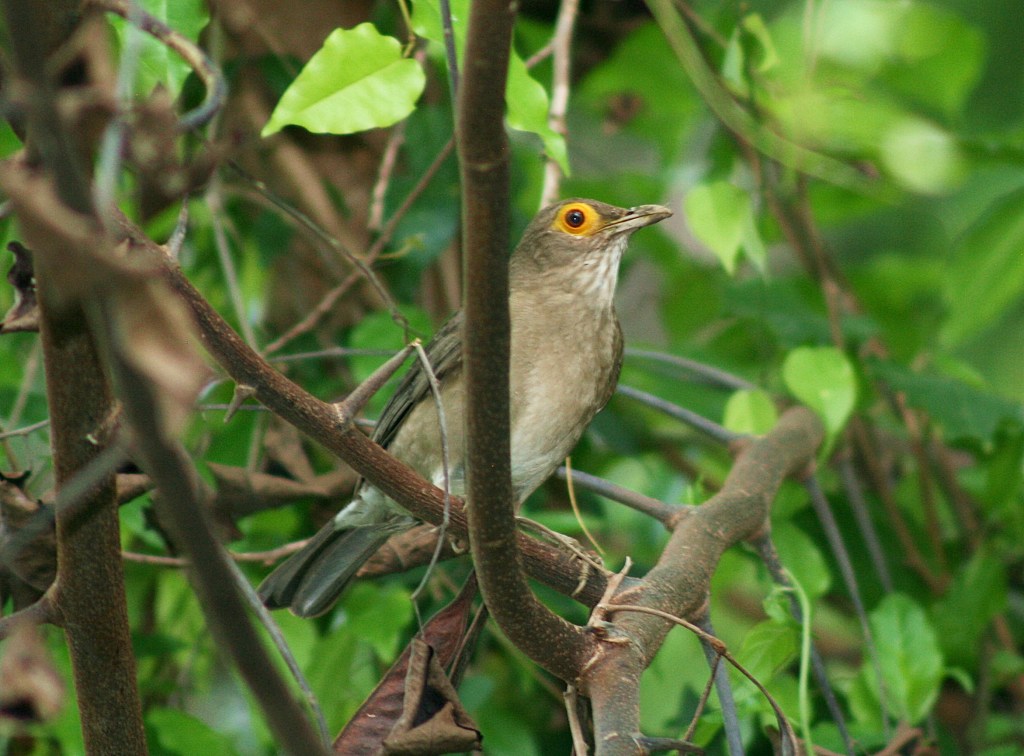
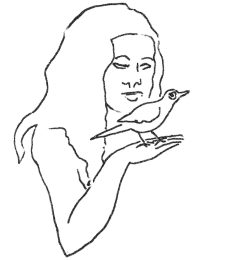
This post is dedicated to Birdy, a nestling Spectacled Thrush that I rescued, raised, and successfully released into his natural habitat a few years ago. He came to us as a weak creature caught in our cat’s jaws, but he left as a determined, incredibly charismatic young thrush, full of life and vitality. After spreading his wings, he used to visit – initially for food, then simply to say hello – but eventually, he moved on to fully embrace the wild, as he was meant to.
Birdy was a true thrush of the genus Turdus in the thrush family, the Turdidae. Thrushes are among the sweetest singers of the Avian world and Birdy’s kind are no exception; although more melancholic than their relatives, Spectacled Thrushes have beautiful mellow voices, which they use to defend territory and attract mates during the breeding season by singing melodies of up-slurred and down-slurred whistles, sweet peeps and ringing trills with plenty of pauses in between.
With several names like Bare-Eyed Thrush and Yellow-Eyes Thrush, the Spectacled Thrush (Turdus nudigenis) is easily recognized by its compact body, upright stance, and stylish taupe mantle with pale underparts. Its most distinctive feature is a bright yellow patch of bare skin around the eyes, which contributes to its many names.
Like most thrushes, it is usually found in woodland and bush land type habitats and has become well adapted to densely vegetated urban areas. It inhabits forest clearings, plantations, coastal shrub, cultivation land, bamboo clumps and our own backyards.
Spectacled Thrushes are common residents of the southern Lesser Antilles – from Guadeloupe to Grenada – as well as Trinidad and Tobago and parts of South America.
They are arboreal, but forage mostly on the ground, typically running or hopping about on strong legs, pausing often to look around, then scratching with their feet or turning over dead leaves with their slender yellow bills to get at earthworms, beetles, moths and any other small invertebrates. They also love fruit, particularly wild berries, papaya, guava and bananas.
Although individuals are typically shy creatures, those living near humans can become quite tame and friendly. In Trinidad and Tobago, they are known to boldly approach tables for food, serenade at windows in the early hours, and even flap or knock against windows to the dismay of the occupants!
In Grenada, our local Spectacled Thrushes regularly visit our banana feeder and enjoy bathing in our bird baths. Interestingly, while most other bird species coexist harmoniously at our feeders, Spectacled Thrushes assert their dominance and do not allow other members of their species, except for their mates, to feed – becoming quite aggressive and nosy during these confrontations. Nevertheless, they coexist peacefully with other species and comfortably share space with tanagers, bananaquits, and mockingbirds while feeding.
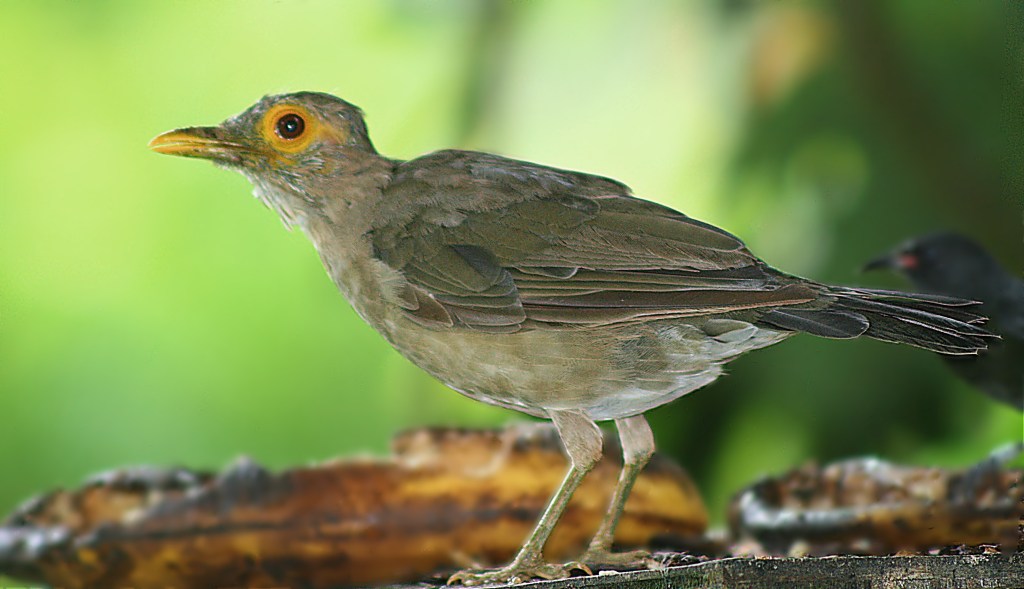
The Spectacled Thrush often prefers to be alone or in pairs, even when there is plenty of food available to gather with others.
Adult males show dominance by making loud, cat-like calls to claim territory and scare off other males. They often emit a rhythmic ‘mew-uh’ sound every few seconds, prompting responses from other thrushes. This vocalization is common throughout the year, especially in the early morning and late afternoon when their calls can lead to physical confrontations.
Spectacled Thrushes are confident birds that show their displeasure when disturbed, whether by people or other sources. They make a annoyed chicken-like sound “kuk…kukkuk…kuk,” which can turn into a more frustrated “kerul-kerul” as they become more uncomfortable.
When annoyed, they fluff up their feathers, raising their tails to look more fierce, or simply hide among leaves. If the disturbance continues, they fly away to find safety. If you hear a call that sounds like a chicken, you might be the cause of the disturbance. This sound can be surprising and might make you expect to see a familiar chicken!
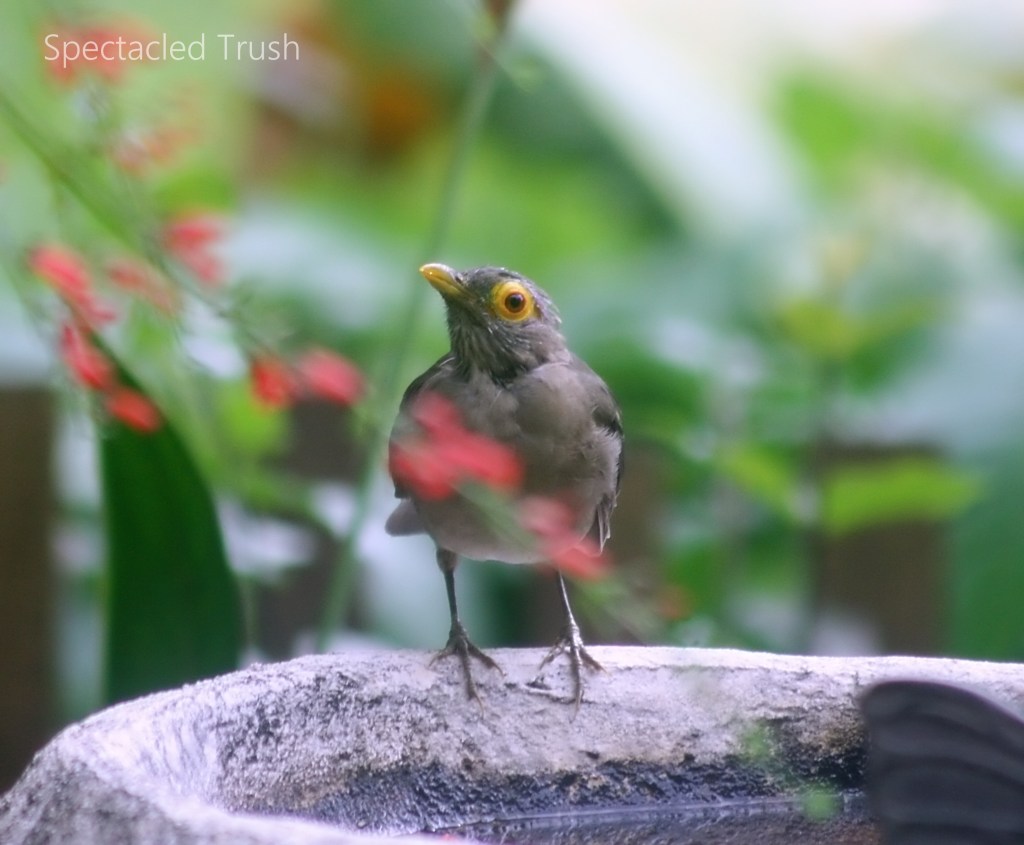
In the West Indies, Spectacled Thrushes show interesting nesting habits, starting their activities when the wet season begins in May and lasts until November. This time provides plenty of food for their young. These birds are loyal, forming monogamous pairs and staying with the same partner and territory for several years.
Their nests, constructed on the fork of a branch, are quite strong, utilizing a diverse range of plant materials like twigs, rootlets, and moss, typically positioned 2-8 meters above the ground on a tree or large shrub. Female thrushes line the nest cup with mud for insulation against varying weather conditions and often embellish it with moss.
Couples protect their nests from predators using their unique “cue-erree” calls. Usually, a male will try to scare off predators by swooping at their heads and making loud, high-pitched screams until the confused intruder, often a hawk, flies away. In urgent situations, the mate and nearby neighbors join in, approaching the hawk from various directions and shouting their warning cries.
The female birds lay 2-4 eggs that can be deep blue or pale blue-green with some markings. During the 13-day incubation, they take care of the eggs while the males guard the nests. The blind hatchlings are cared for by both parents and fed nutrient-rich earthworms every ten minutes.
Raising Birdy taught me that collecting worms is harder than it seems! So, Birdy mainly ate softened cat kibble, with some earthworms or caterpillars now and then.
Initially, I ensured frequent feedings, but over time, Birdy established his own eating schedule. If I attempted to encourage him to eat more, he would grasp the morsel in his beak, turn away from me, and drop it. I believe I saw the little rascal emit a gleeful chuckle each time it carried out that action!
Birdy fledged at about 15 days old but needed my help for another six weeks. In the wild, fledglings stay close to their dad for at least a month while their mom may start laying another clutch. Young birds look like adults but can be recognized by lighter buff streaks on their brown feathers, two orange bars on their wings, a spotted breast, and a thinner, paler eye-ring. They reach maturity when their eye-ring is fully developed.
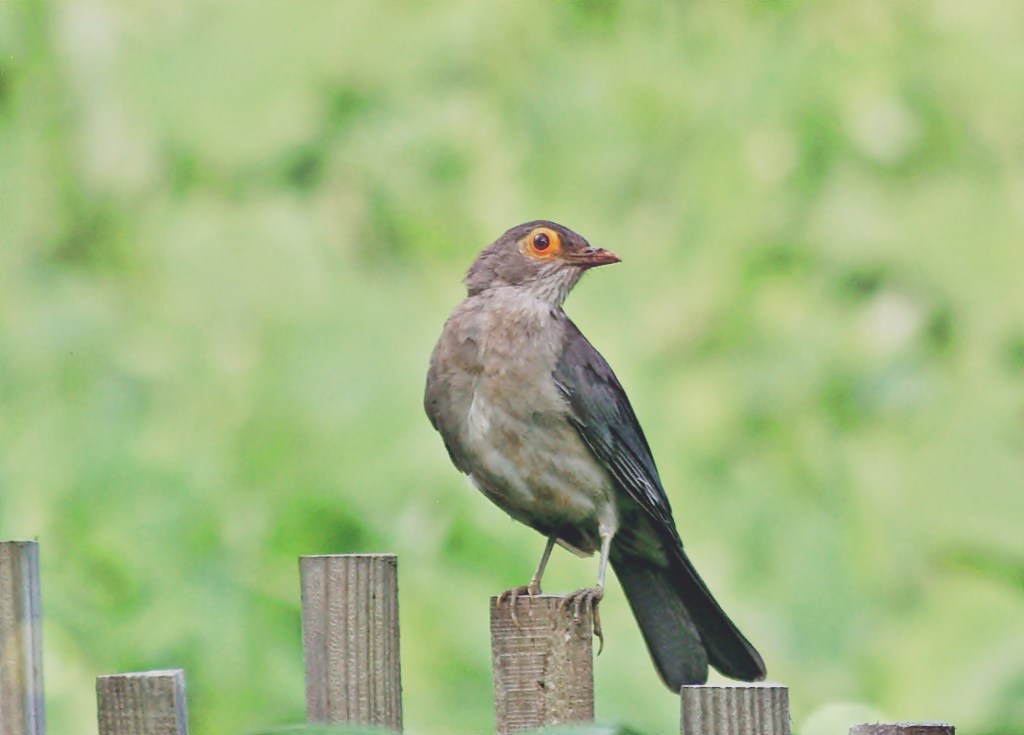
Spectacled Thrushes are vulnerable to feather parasites, spending a lot of time grooming, bathing, and sunbathing. Even without formal training, Birdy naturally included these activities in his daily life.
His bathing rituals were quite the spectacle, involving full submersion, accompanied by vigorous wing and tail fluttering to ensure thorough soaking. During sunbathing sessions, onlookers were treated to the sight of Birdy assuming unconventional positions to bask in the sun’s rays. With contorted body, splayed tail, and fluffed feathers accentuated by the brilliant eye-ring, Birdy appeared to shimmer like gold in the sunlight.

 BELA'S BIRDS