
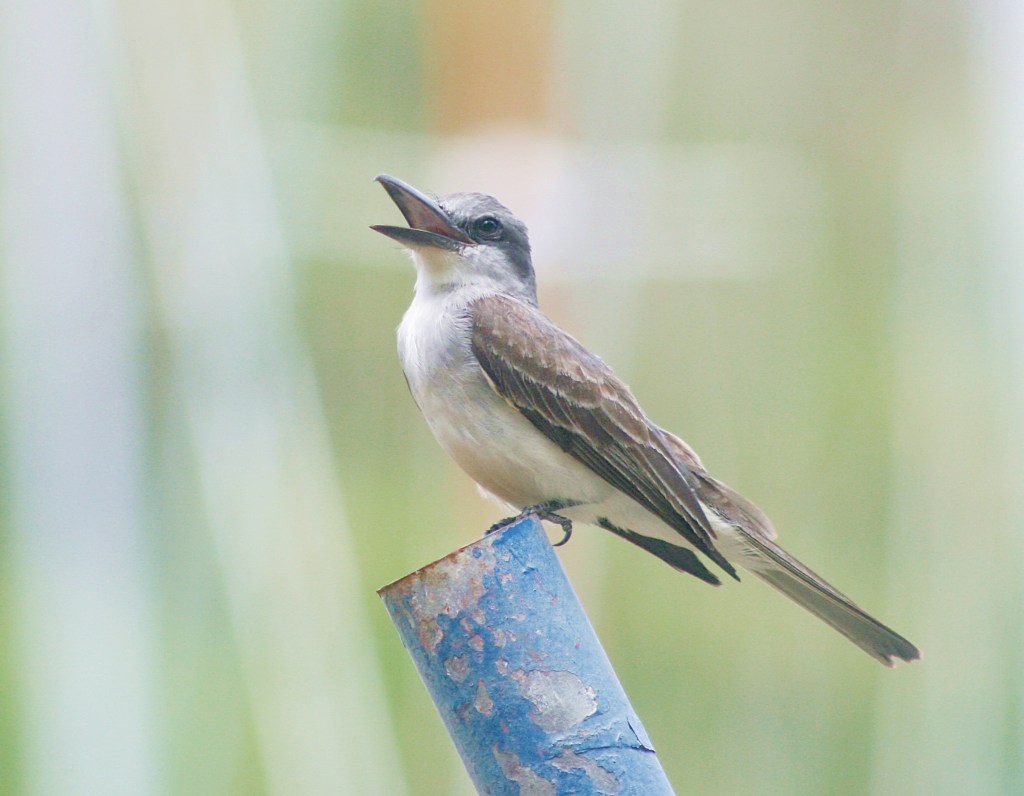
I often see him perched on a mangrove tree, standing tall with his head held high and eyes bright with assertiveness. Dressed simply, he flies gracefully, diving to catch an insect and then chasing away a passing bird. His loud calls of “Pit-pitiri-ri-ree! Pitcherreee!” ring out through his territory, and I can almost picture him saying, “Look at me! I am the ruler!”
The Grey Kingbird is an important member of the Antillean Flycatchers and is part of the Tyrant-Flycatchers (Tyrannidae) family.
True to its scientific name Tyrannus dominicensis, this species shows typical ‘tyrant’ characteristics. It has two subspecies: the main one, T. dominicensis dominicensis, found in the southeastern US, Bahamas, Greater Antilles, Trinidad and Tobago, eastern Venezuela, Bonaire, Curaçao, Colombia, and Panama; and the larger, darker T. dominicensis vorax, which lives in the Lesser Antilles and has a longer bill. In winter, T.d. dominicensis migrates to northern South America.
The Grey Kingbird has a grey forked tail and is the largest eastern Caribbean Tyrant Flycatcher, measuring 23-24 cm (9-9.5 inches) long. Males and females are similar in appearance, but the female has a slightly smaller crown.
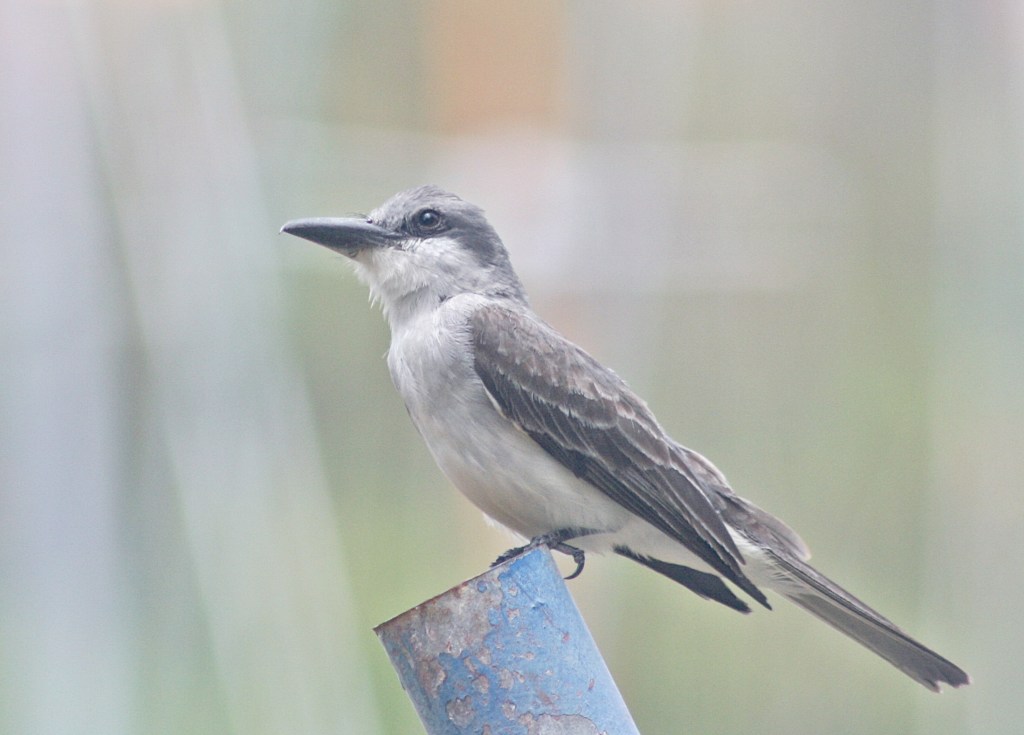
The Grey Kingbird, also called Pipiri, Rain bird, and Pitiwick, is a skilled hunter that catches insects using techniques like “perch hunting,” “aerial hawking,” and “sallying.” They eat large flying insects like cicadas, beetles, and grasshoppers, along with some lizards and hummingbirds. They manage larger prey by striking moths against their perch before eating. Besides insects, they also like various fruits and berries.
Grey Kingbirds nest from April to July and they are known for their courtship flights. During the breeding season, males assert their territory with a loud call, “pi-ti-ree-pi-ti-roo!” Pairs showcase impressive aerial feats, diving 25 meters while calling to each other. They also carry out eye-catching ‘wing fluttering’ displays, giving the appearance of walking on air with quick, light wing beats.
Males and females have different roles during nesting season. Females build the nests, incubate the eggs, and care for the chicks, while males protect the nest and help feed the chicks.
Grey Kingbirds build their nests using small twigs and grass, typically on the tops of trees. While they may appear delicate at first glance, a closer inspection reveals that the nests are remarkably strong.
The females lay 3-5 pale pink eggs and nurture them for approximately two weeks. The chicks leave the nest at about 18 days old but continue to depend on their parents for an additional 3-5 weeks. Grey Kingbirds also face the risk of Shiny Cowbirds trying to lay eggs in their nests. Despite this, these birds bravely protect their nests to keep their young safe.
Indeed, the Grey Kingbird, a small yet powerful bird, rules its territory with strength. It is steadfast in safeguarding its nest and domain, confronting all intruders, including Shiny Cowbirds, various other birds, fellow Kingbirds, and even mammals. Witnessing this agile bird successfully fend off a much larger predator is truly awe-inspiring. For this reason, the Grey Kingbird has become the symbol of Puerto Rico’s independence movement.
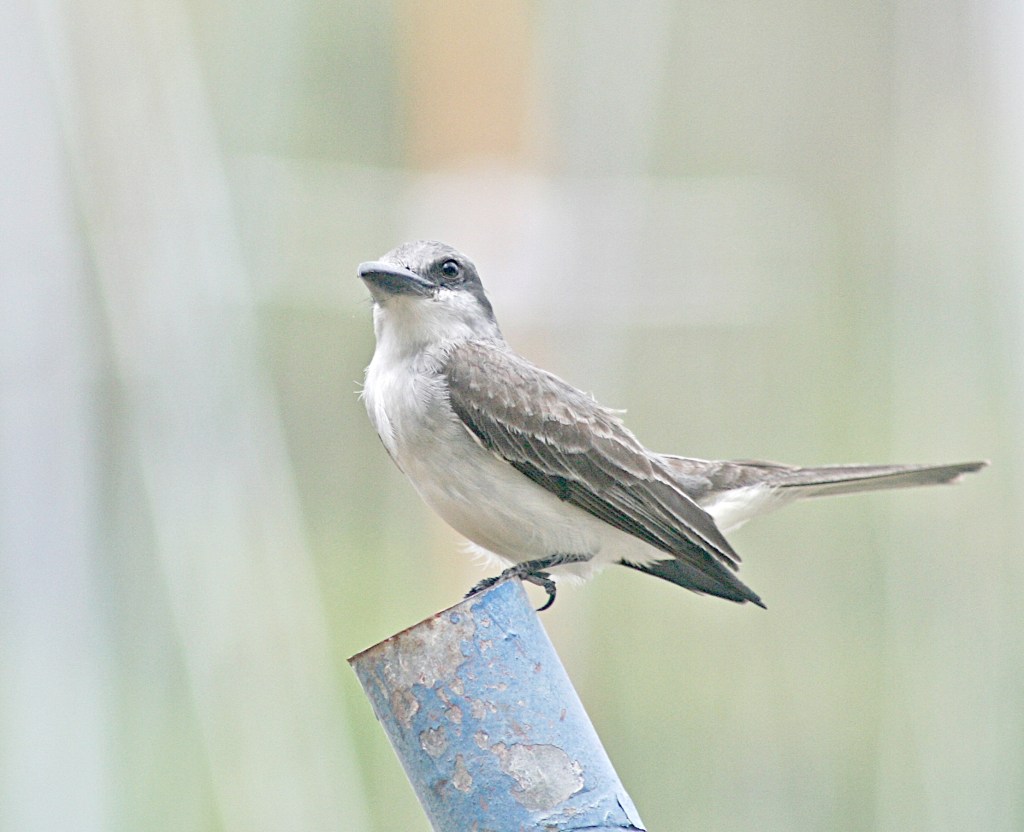
Although its strong determination poses a tough challenge for its competitors, it can sometimes be a challenge for people too. This was clearly shown when my husband and I found a Grey Kingbird trapped in our local supermarket in Grenada. The proud bird, stuck in the air-conditioned space for two days with very little to eat, showed clear signs of distress. Despite the staff’s ongoing attempts to guide him to freedom, the bird frustratingly flew from one end of the room to the other, desperately looking for an exit while clinging to the ceiling. With some patience and carefully handled long brooms, we kept him in flight until he grew tired and descended closer to the ground, briefly losing his dignified composure.
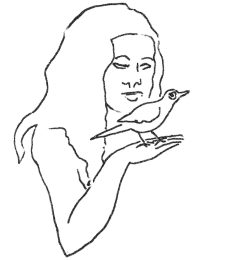
As I held the bird, I noticed how delicate he felt in my hands. When I stepped into the sunlight, he quickly relaxed and soon flew up into the sky with strength and grace, heading towards nearby trees to do his important work.

 BELA'S BIRDS