
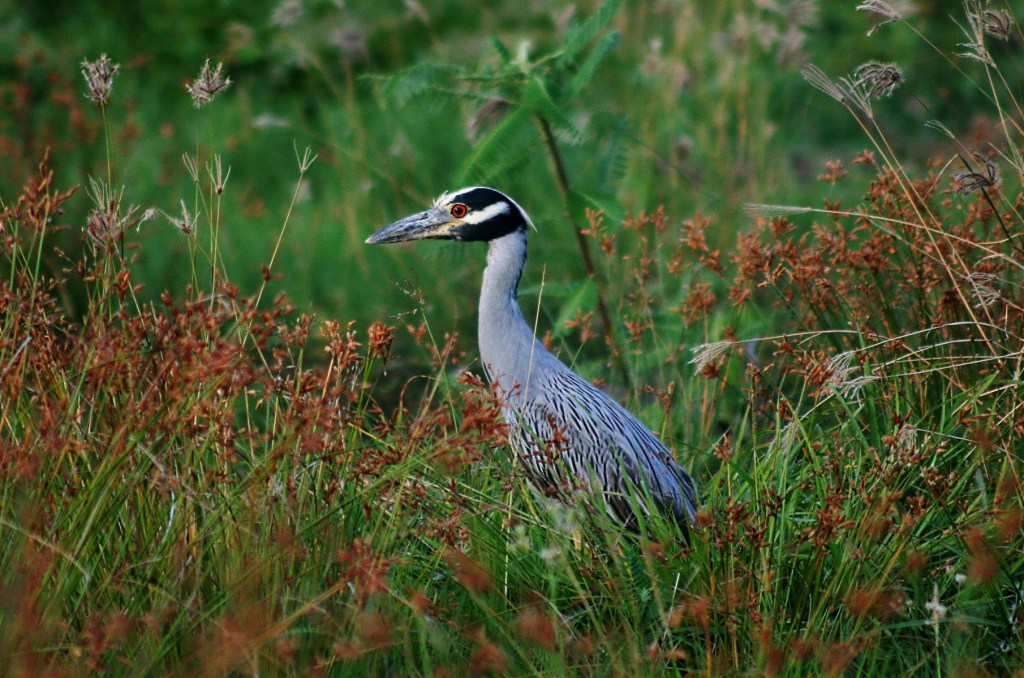
Our neighbours have interesting habits; they stay up all night, chatting in a foreign language and making loud calls late at night. At sunrise, they greet the new morning cheerfully, with ruffled feathers and charming smiles.
Our neighbours are not your usual residents; they are a small group of about six Yellow-Crowned Night Herons (Nyctanassa violacea) that roost on the large branches of a Kapok tree (Ceiba pentandra) just a hundred meters from our home in Grenada. This tree, known in the West Indies as the “silk-cotton tree,” “god tree,” and “devil tree,” is often associated with the supernatural. A local legend from Trinidad and Tobago says that the devil lives in a Kapok tree deep in the forest. It seems appropriate that our “devil tree” houses these semi-nocturnal herons with their striking, demon-like eyes. Yellow-Crowned Night Herons have deep orange eyes that turn bright red during breeding season. Unlike the spooky creatures of folklore, adult Yellow-Crowned Night Herons are graceful and beautiful.
Yellow-Crowned Night Herons were once thought to be closely related to Black-Crowned Night Herons (Nycticorax nicticorax), but DNA analysis has shown they are genetically distinct. This has led to their classification in a separate genus, Nyctanassa, which means “night-lady” or “night-queen” in ancient Greek, reflecting their beauty and nocturnal habits. They are active both day and night, dedicating equal time to hunting after dark as they do in the daylight. Their large eyes help them see in low light, especially at dusk and night.
The Yellow-Crowned Heron can be found as far north as Virginia in the United States but mainly thrives in the tropical climates of the Americas, especially in freshwater and coastal areas. They are common throughout the West Indies, where they live in mangrove swamps, marshes, creeks, and saline ponds. They are the most sedentary foragers among American herons, spending over 80% of their time feeding while standing still.
These birds make snake-like swaying movements while hunting before striking their prey. Their diet mainly includes crayfish and crabs, especially fiddler crabs, mangrove crabs, and land crabs. In colder areas, where fiddler crabs go into their burrows at temperatures below 15° C (59° F), Yellow-Crowned Night Herons move to warmer tropical and subtropical regions, like the West Indies, where crabs are available year-round.
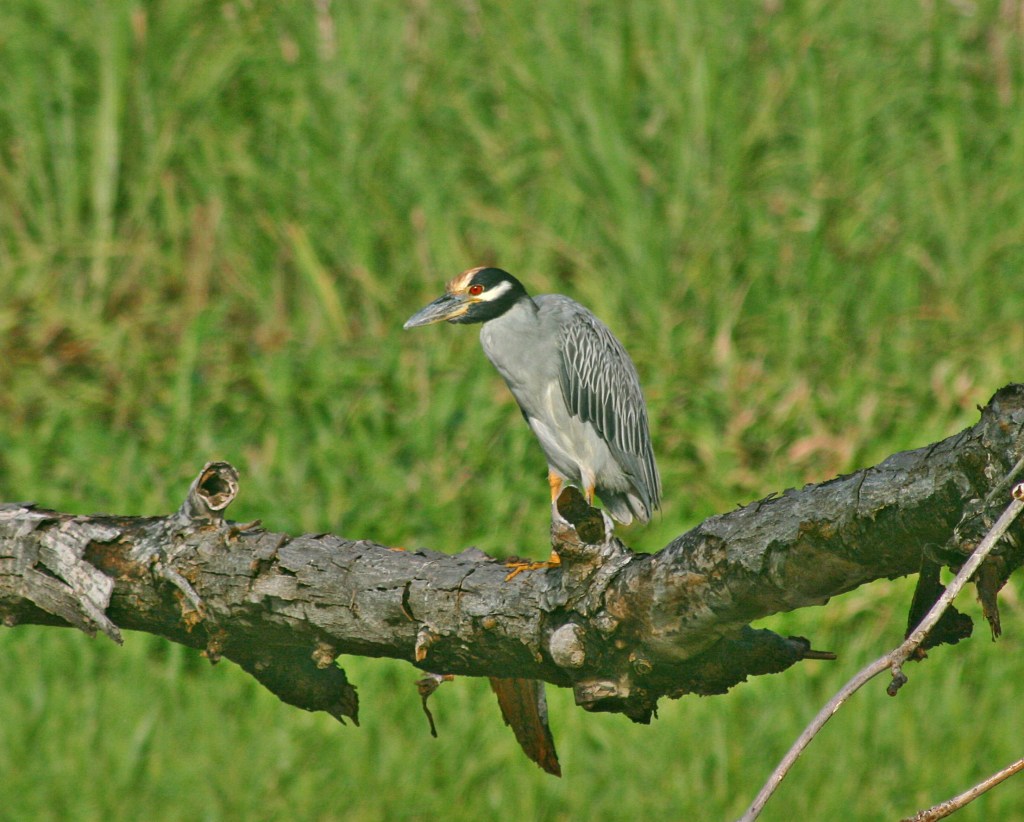
The crabs are usually captured by their legs or pincers and taken to a place where they cannot escape. With great skill, the heron shakes the crab to remove its pincers and legs before eating it whole, starting with the body. It may also use its bill to poke through the crab’s shell, which helps to immobilize it and makes it easier to handle.
These herons feed mainly feeds on crabs, with bill size changing depending on crab availability in various locations. For example, West Indian populations have stronger bills for eating large, hard-shelled crabs. While they focus on crabs, these birds also eat insects, frogs, tadpoles, snakes, lizards, young birds, small mammals, and sometimes I even joke about them eating small children.
Yellow-Crowned Night Herons time their breeding season to coincide with the rainy season, which ensures more crabs are available for food. A study by The Center for Conservation Biology at Virginia Commonwealth University has shown that the Yellow-Crowned can adapt to climate change. Data reveals that migratory populations have changed their nesting season by more than 20 days over the last 50 years. Comparing incubation dates from the 1960s to 2015 shows that these birds in Virginia’s Tidewater region are now arriving and laying eggs earlier, responding to the earlier spring and longer fiddler crab season.

But returning to our neighbours, they keep a respectful distance, allowing me occasional glimpses into their daily lives. Last April, I was intrigued as a pair built a nest on a fork of the Kapok tree. The smaller female skillfully wove the nest, while the male brought twigs, landing just below the nest each time and carefully climbing to her with a large twig in his strong mandibles, balancing along the thorny branch. Below them, a juvenile, likely from the previous breeding season, dressed in mottled brown with bright red eyes, watched and learned.

As I finish my article, the sunset glows warmly and my neighbours’ loud calls fill the air as they fly to their feeding grounds nearby. I feel lucky to share my space with these evening birds with their strange ruby eyes, and watch them fade into the twilight – until morning arrives.

 BELA'S BIRDS