
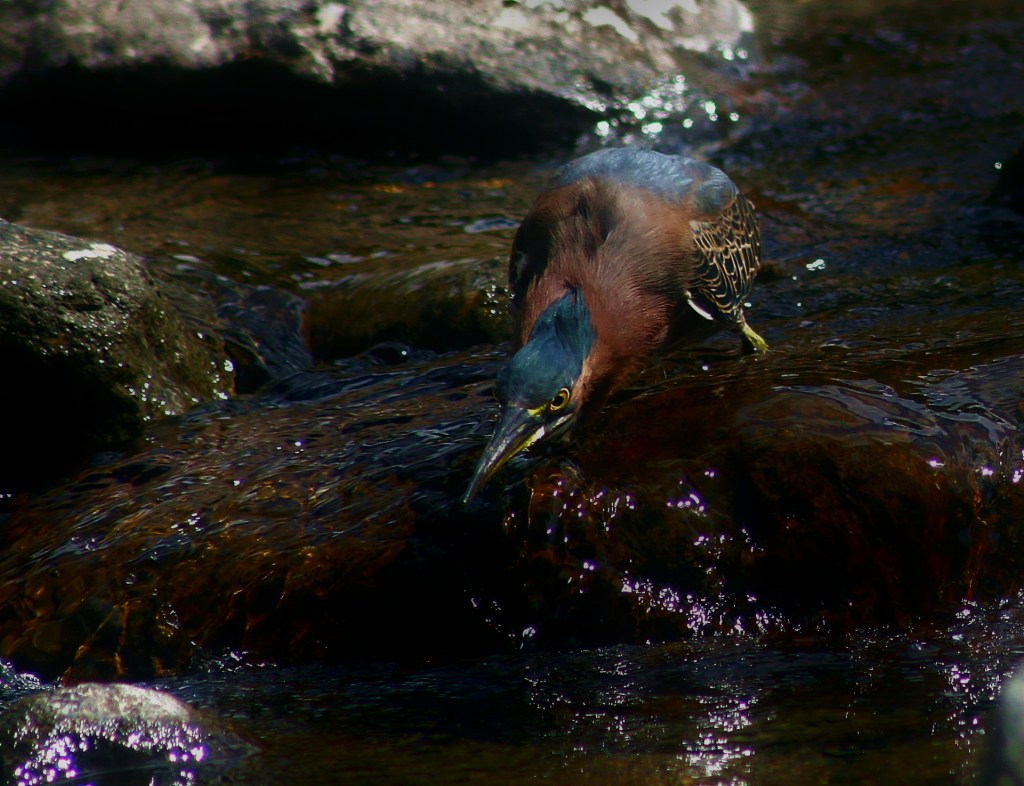
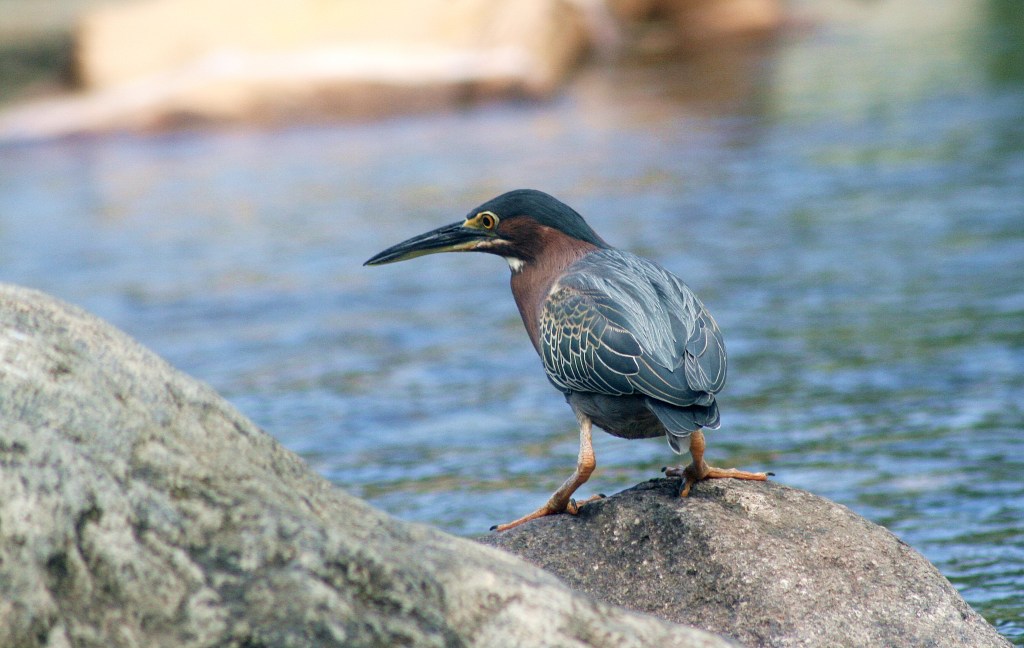
A few years ago, I encountered a Green Heron fishing in a shaded mountain stream within Grenada’s rainforest, its rich chestnut colors glimmering in the dappled sunlight. Suddenly, it took flight with a loud, irritated squawk that shattered the monotonous sounds of the rushing creek. This was my first glimpse of the bird. Later, I spotted another one at La Sagesse’s salt pond—a solitary, hunched silhouette concealed among the tangled leaves and dark roots of the mangrove trees. I leaned in for a closer look, but in an instant, it soared away on its delicate, ethereal wings, leaving behind nothing but a faint echo, a fleeting note, a ghostly shadow.
My first experiences with the Green Heron revealed that they can be both timid and easily startled, yet also quite daring, as they are often seen fishing in fancy hotel ponds and urban ditches, appearing entirely unbothered by the hubbub of nearby humans.
Indeed, while visiting the northern town of Victoria in Grenada, I spotted two Green Herons fishing on the small river that flows through the town suburbs. I spent hours tracking their slow movements upstream, amazed by their calmness amid the cacophony of honking cars, booming music, children shouting, and even someone plucking a chicken just a few meters away from the herons!
I was struck to see that one of the herons had only one leg, yet it seemed entirely unfazed by its situation. When its companion drew a bit too close, the one-legged bird assertively pushed it away before returning to its fishing spot, landing with surprising ease. It rested its body against a boulder for stability while watching and waiting for fish to approach.
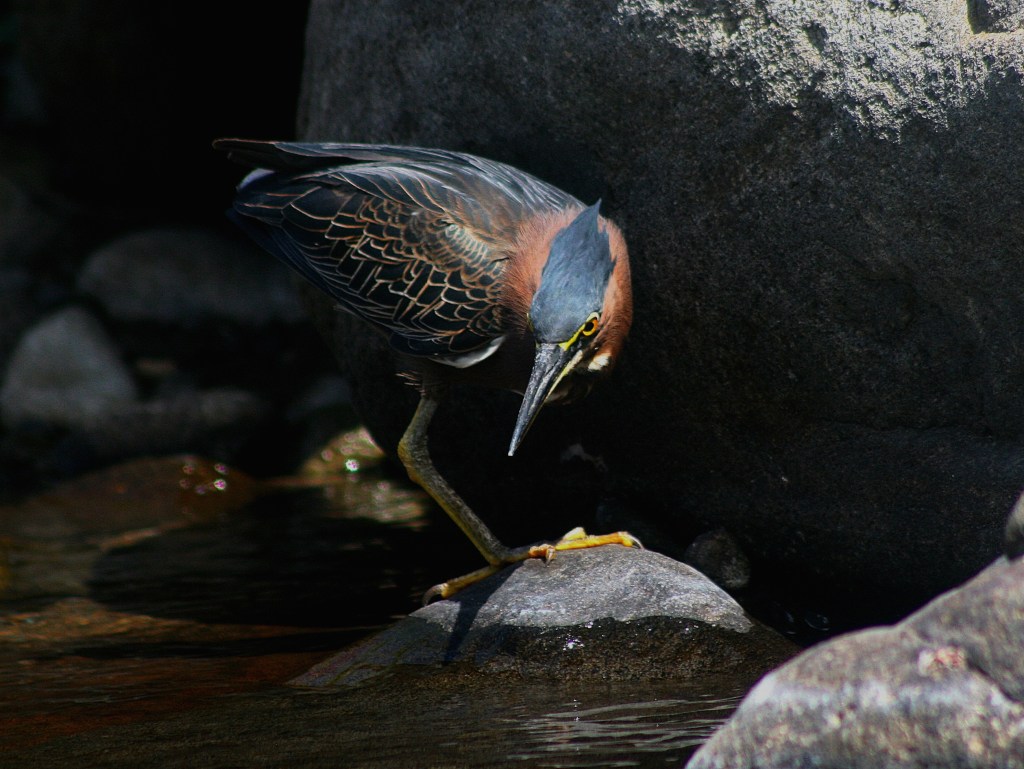
The herons remained motionless, gazing at the water for long periods, their necks coiled and sharp bills poised to strike at any passing fish. Green Herons can extend their long necks remarkably far, and their movements resemble those of a striking snake—quick and graceful.
Many bird species excel at fishing, but only a select few use tools to aid in their hunt. Notably, some Green Herons have been observed using insects, bread crusts, earthworms, twigs, and feathers as fishing lures by placing them on the water’s surface to attract and capture fish. Watching them is remarkable as they patiently adjust the lure, ultimately reaping rewards in the form of sizable fish, which they swiftly snatch, flip, and consume headfirst.
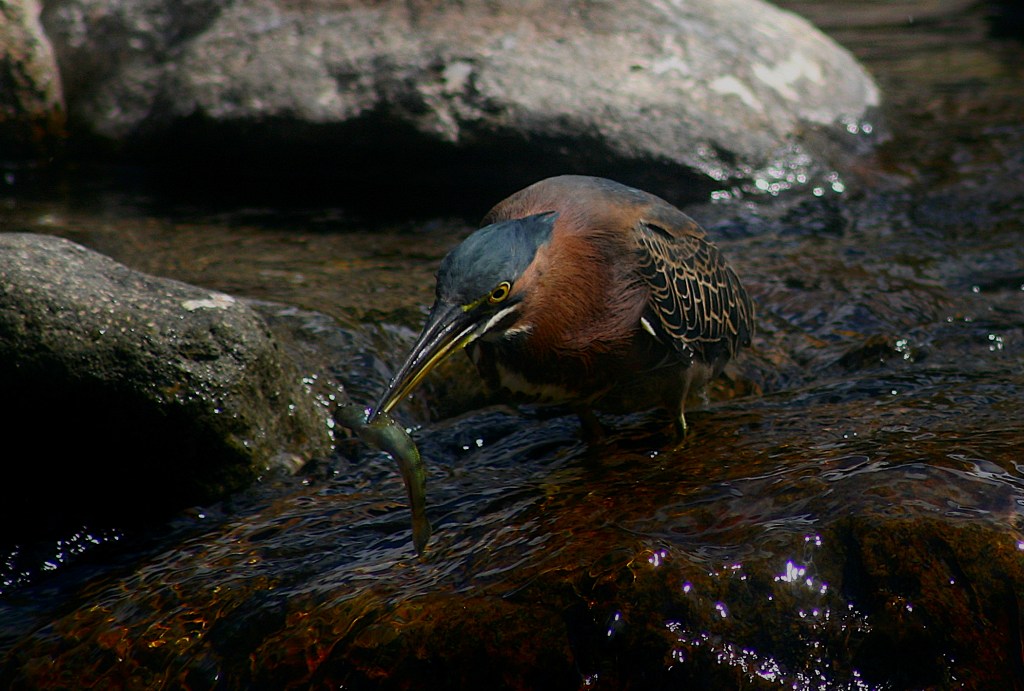
Scientists are still trying to comprehend how these remarkable birds learnt to use lures. The hypothesis that they acquired this behavior from observing humans was dismissed after unsuccessful attempts to teach them to use bait. A more plausible explanation is that they gain knowledge through experience; for example, in “Gone Fishing. Who is a Clever Birdie?!!!” by David Hogg, Green Herons at a hotel pond in Grenada observed the influx of fish that followed bread thrown into the water by guests, and soon began to snatch the bread crusts to use as bait. The herons were never seen consuming the bread, and when offered bread away from the lake, they promptly run to the water to use it as a lure.
But why don’t all Green Herons use lures? Some scientists suggest that only the most intelligent herons can associate the act of dropping bread into the water with the resulting fish frenzy, which may explain why not all engage in fish-baiting. On the other hand, others believe that the inconsistency of this behavior stems from many herons not having the opportunity to see the effects of bait sinking into the water. Nevertheless, it could be that those herons that do use bait are indeed the Einsteins of their species, independently developing innovative and complex strategies for obtaining food.
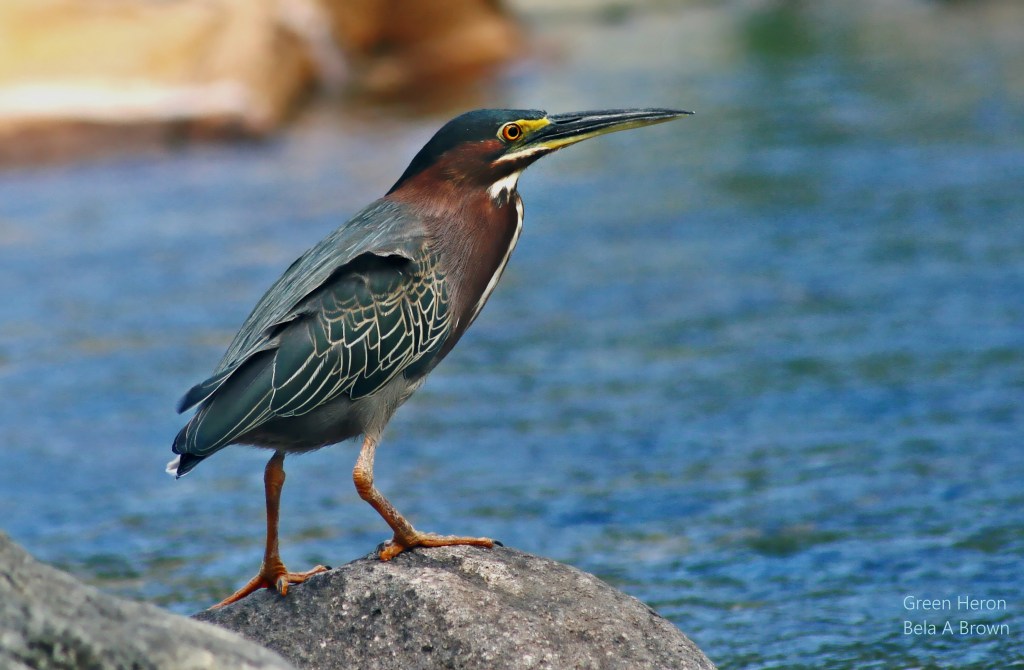
Green Herons show partial migratory behavior, with populations from cooler regions moving southward during winter to Central America, the West Indies, and northern South America. Birds from northern habitats are known for their extensive dispersal, having been spotted as far away as Greenland, the United Kingdom, and France. In contrast, tropical populations stay sedentary. These herons prefer freshwater and brackish environments, including lakes, ponds, swamps, and rivers surrounded by dense shrubs, mangroves, or tree islands, which give ideal locations for feeding, roosting, and constructing their platform nests. Their nests are built over water, typically up to two meters above the ground.
In the West Indies, the nesting season is influenced by mangrove flooding and the rise in temperatures linked to the rainy season around June to July. During this period, breeding birds develop glossy black bills, blue-black lores, and vibrant orange-red legs. They form seasonal monogamous pairs and typically nest in isolation, though they may occasionally join mixed-species colonies, remaining somewhat separate and outnumbered by other birds.
Courtship is a spectacle worth mentioning featuring vibrant aerial displays paired with “skow” calls and ground displays like ‘’the Stretch’’, where the male raises his bill skyward, stretches, and bends his neck backward until his head nearly touches his back, with back plumes erect and fanned. He sways his head and neck from side to side, eyes bulging, as the irises transition from yellow to deep orange, while calling “aarooo-aarooo”. After this, the female executes a milder version of ‘’the Stretch’’ and is then permitted to step onto the half-built nest platform for the first time. Both birds continue to repeat this display throughout the nest building and incubation phases, especially during nest relief ceremonies.
The young are born semi-altricial, receiving care from both parents. Chicks develop rapidly and can achieve independence as early as 30-35 days; nevertheless, they continue to be guided by adults for an extra month to learn how to fish.
In the West Indies, predation on eggs and chicks is high, especially from tree boas, manicou (common opossum), mongooses, and broad-winged hawks. Luckily, Green Herons have an instinctive ability to recognize threats. A study titled “Avoidance of Venomous Sea Snakes by Naive Herons and Egrets,” conducted by the zoology department at the University of California and the Smithsonian Tropical Research Institute, observed six inexperienced, hand-reared birds from Panama. When confronted with a dead sea snake, these birds reacted with panic: they backed away with raised crests, flew around the aviary, and scratched at the gates with their feet and bills in a bid to escape, demonstrating behavior they had never exhibited before.
For many people, one intriguing aspect of Green Herons is their name. Why are they called Green when they don’t actually appear green? Their name comes from the darker feathers on their backs and the dark cap that fluffs into a shaggy crest when the bird senses danger. These darker feathers are iridescent; although they seem dark blue or black, they reveal a green hue in the right lighting. Besides their common name, Green Herons are also known by several amusing nicknames due to their habit of leaving a trail of white droppings when startled, resulting in names like ‘poke,’ ‘fly-up-the-creek,’ ‘chalk-line,’ and ‘shite-polk.’
The species is classified under the genus Butorides, which translates to ‘resembling a bittern’. This genus includes three nearly indistinguishable species: the Green Heron found in the new-world tropics, the Striated Heron native to the old-world tropics, and the Lava Heron from the Galapagos. Collectively, these three species are referred to as the Green-backed Heron.
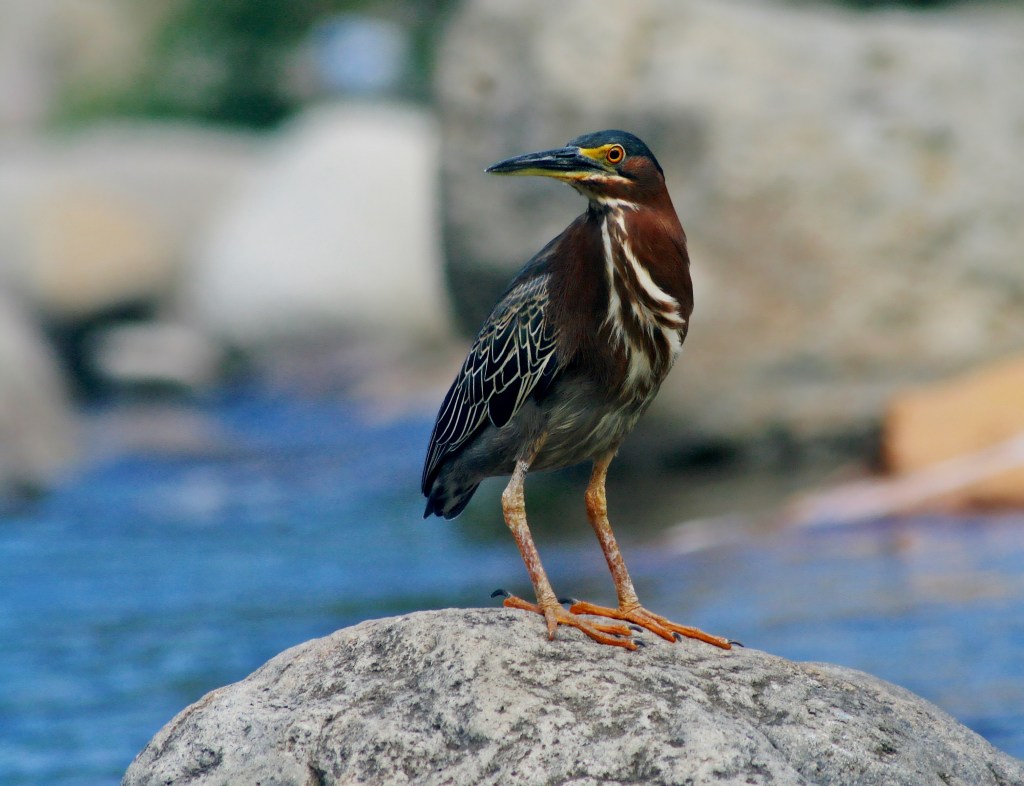
Well, as I conclude my writings, I must confess my fascination with the Green Heron, and I hope you share this interest! If you ever find yourself in the Caribbean, make sure to keep an eye out for these amazing birds along the rivers, swamps, and beaches. They can be seen standing at the water’s edge, wading through shallow waters, or even hanging upside down from overhanging branches while fishing below. In deeper waters, you may notice them swimming and diving for prey – they have webbing between their middle and outer toes, enabling them to swim gracefully and upright, like funny little swans.


 BELA'S BIRDS