
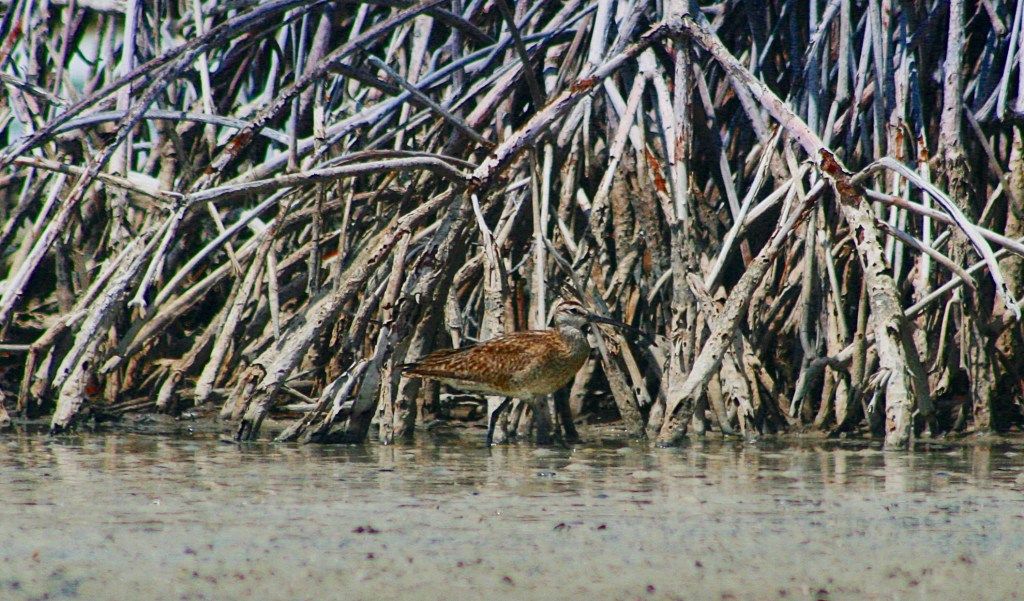
A mournful ‘’wit-tit-tit-tit-tit-tit’’ echoed through the mangrove swamp as a whimbrel rose into the sky on its slender wings and touched down on the far shore of a mangrove inlet in Woburn Bay, a protected marine area along Grenada’s southern coast. With its mottled brown and straw-patterned feathers, it carefully navigated the mud at the edge of the mangrove, casting cautious looks in my direction while stopping to forage for its favorite prey — the fiddler crab, which its crescent-shaped bill is well suited to snatch.
The Whimbrel (Numenius phaeopus) has garnered various names throughout history that reflect both its physical traits and its calls. The English name originates from its cry, reminiscent of a dog’s whimper. In Malaysia, the bird’s long, curved bill conjures images of elephants, leading to the moniker “elephant bird.” In ancient Greece, this distinctive bill was compared to a crescent moon, giving rise to the term neos mene, which means “new moon” and ultimately evolved into the Latin Numenius, representing the genus that includes curlews.
Did you know that the Whimbrel is the most widespread among the eight curlew species? Indeed, there are four subspecies, each exhibiting slight variations in color and size. In the West Indies, we find the North American subspecies N.p. hudsonicus, which was previously classified as a separate species known as the Hudsonian Curlew until 1957. This subspecies has two primary breeding populations: one in western Canada and Alaska that winters along the Pacific coast, and another in the Hudson Bay region that migrates to the West Indies and northeastern South America.
Speaking of migration, did you know that Whimbrels are truly remarkable long-distance travelers?
In 2008, biologists from the Center for Conservation Biology (CCB) placed satellite transmitters on over 20 whimbrels to study their migration and challenges. One whimbrel, named Winnie, surprised researchers by flying 3,200 miles from the Delmarva Peninsula on the U.S. East Coast to the Mackenzie River delta in Alaska during her northern migration. This journey showed that western whimbrels migrate much farther than previously believed!
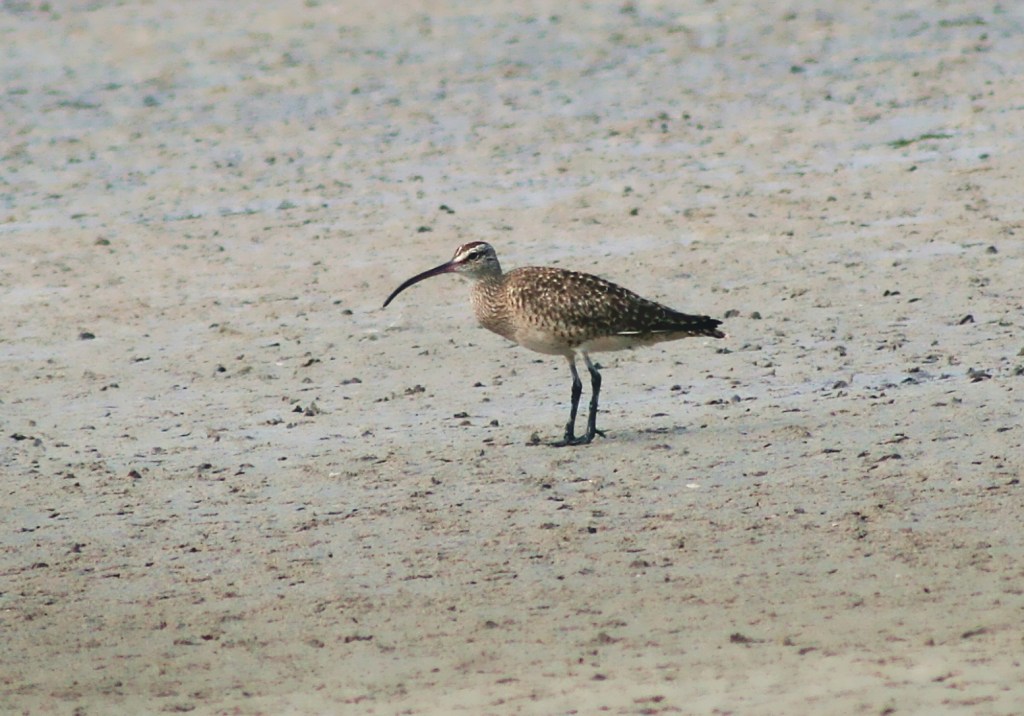
In 2012, four Alaskan Whimbrels amazed biologists by taking a new route to South America, flying over the ocean. Named Mackenzie, Taglu, Pingo, and Akpik, they left their breeding grounds in the Mackenzie River delta and stopped in James Bay and the Gulf of St. Lawrence in Eastern Canada for two weeks to build fat reserves in preparation for the long journey. Then, they began an impressive ocean flight southeast into the Atlantic Ocean, eventually reaching land between Guyana and Brazil. At one point, they were 1,000 miles closer to Africa than North America and only 700 miles from the Cape Verde islands, with Mackenzie completing the longest non-stop journey of 4,355 miles in 145 hours, or six days!
Considering that the open ocean is home to seabirds that can land on water, it is impressive that whimbrels—a species that can’t land on water—can fly so far from shore, using their strong wing beats powered by fat reserves. While the reasons for these ocean flights are not clear, possible benefits may include fewer storms, less danger from predators, and better tailwinds.
Whimbrels have also amazed scientists with their ability to navigate through several significant storms. A notable instance is Chinquapin, who endured two hurricanes in consecutive years, including Hurricane Irene in 2011, by flying directly through its most perilous northern quadrant!
Yet, even the strongest birds need a safe place to rest. In September 2011, as Goshen and Machi flew south to Brazil, they faced tropical storms—Machi with Maria and Goshen with Irene. After these storms, the tired birds stopped in Guadeloupe to rest and refuel, but sadly, they were met by hunters. The news of Machi and Goshen’s deaths spread worldwide, highlighting the struggles of many shorebirds arriving in the French West Indies every autumn. In response, conservation groups pushed for stricter hunting rules, and after much effort, Guadeloupe and other island nations set limits on hunting certain species. Thankfully, Goshen and Machi did not die in vain; their story has helped protect many shorebirds from a similar fate.
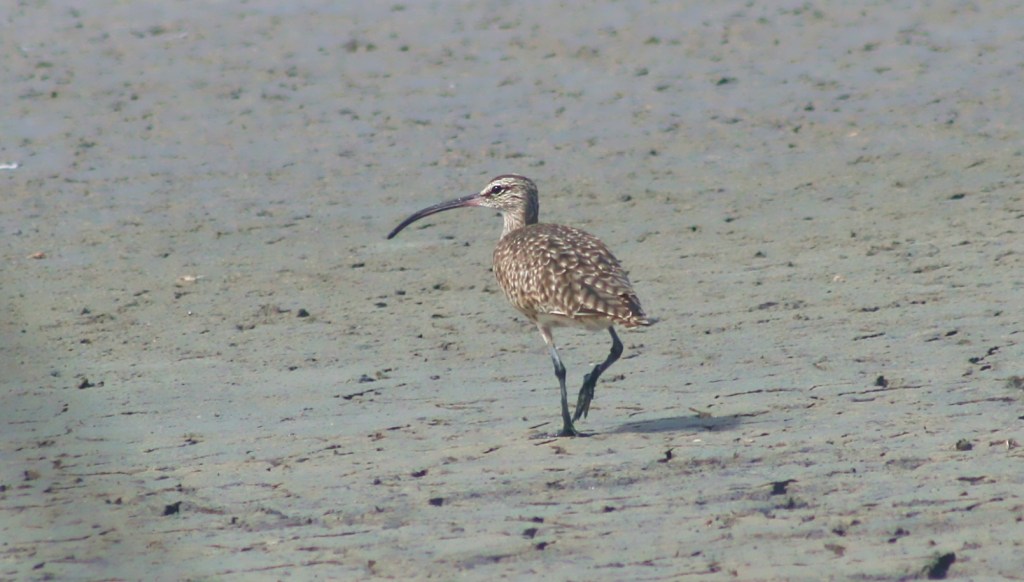
The Caribbean Islands are an important stop for migrating whimbrels and a winter home for birds like Hope. For ten years, Hope flew long distances each year, moving from her breeding grounds in McKenzie, Northwest Alaska, to her winter home at Great Pond, a 50-hectare mangrove swamp in St. Croix, US Virgin Islands.
Hope showed great bravery in 2011 when she faced tropical storm Gert, flying through strong winds at an average speed of 9 mph and taking 27 hours to reach the center of the storm. Afterward, she sped up to nearly 100 mph for 1.5 hours. Once out of the storm, she made a quick right turn, using the tailwinds to head toward land and a refueling station in Cape Cod. Sadly, in 2017, just two weeks after surviving category 5 hurricane Irma, Hope was hit by hurricane Maria, which severely affected Great Pond, causing significant damage. She has not been seen since.
In her remarkable life, Hope taught us a lot about whimbrel migration. She was featured on a website that let biologists, the public, and schools worldwide track her journeys. Through her, Hope connected different nations, languages, and cultures. Her loyalty to Great Pond made her a celebrity and crucial to efforts to protect her habitat, which is now recognized as “An Important Bird Area” by Birdlife International and a safe space for at least 72 bird species. Today, Hope is remembered in a children’s book called ‘’Hope is Here’’, written by Cristina Kessler, inspiring both children and adults to help protect the vital wetlands for her species.

 BELA'S BIRDS