
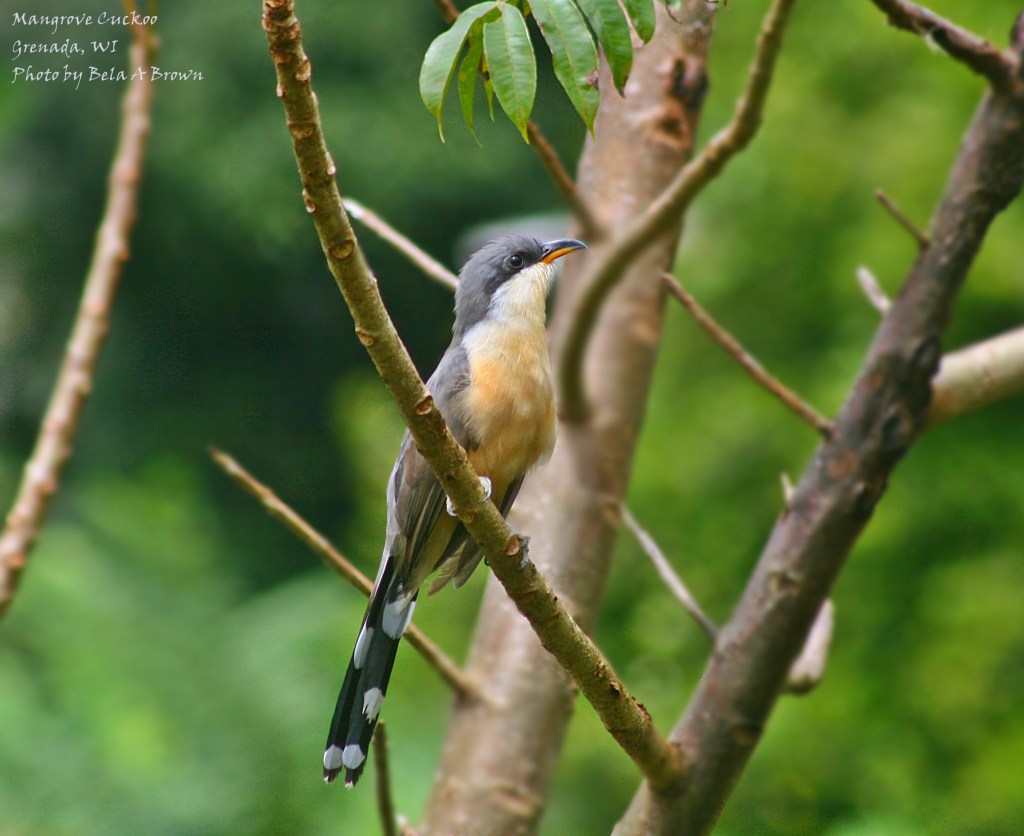
When I first heard the call of the Mangrove Cuckoo, I didn’t realize it was a bird; the sound was a deep ahrk-ahrk-ahrk-ahrk-ahrk that resembled a large frog laughing or burping. Sometimes it sounded like the frog was growling – kruk-kruk-kruk-kruk – with the quick notes blending together. It soon became clear that the strange croaking was actually a bird calling from the tree branches.
Spotting the croaker was challenging; I kept my eyes on the trees, but it always eluded me, its croaking mocking me. One day, I followed the call to a nearby tree on the roadside and saw a beautiful bird looking at me from a lower branch – I took a moment to link the croak with the lovely cuckoo in front of me!
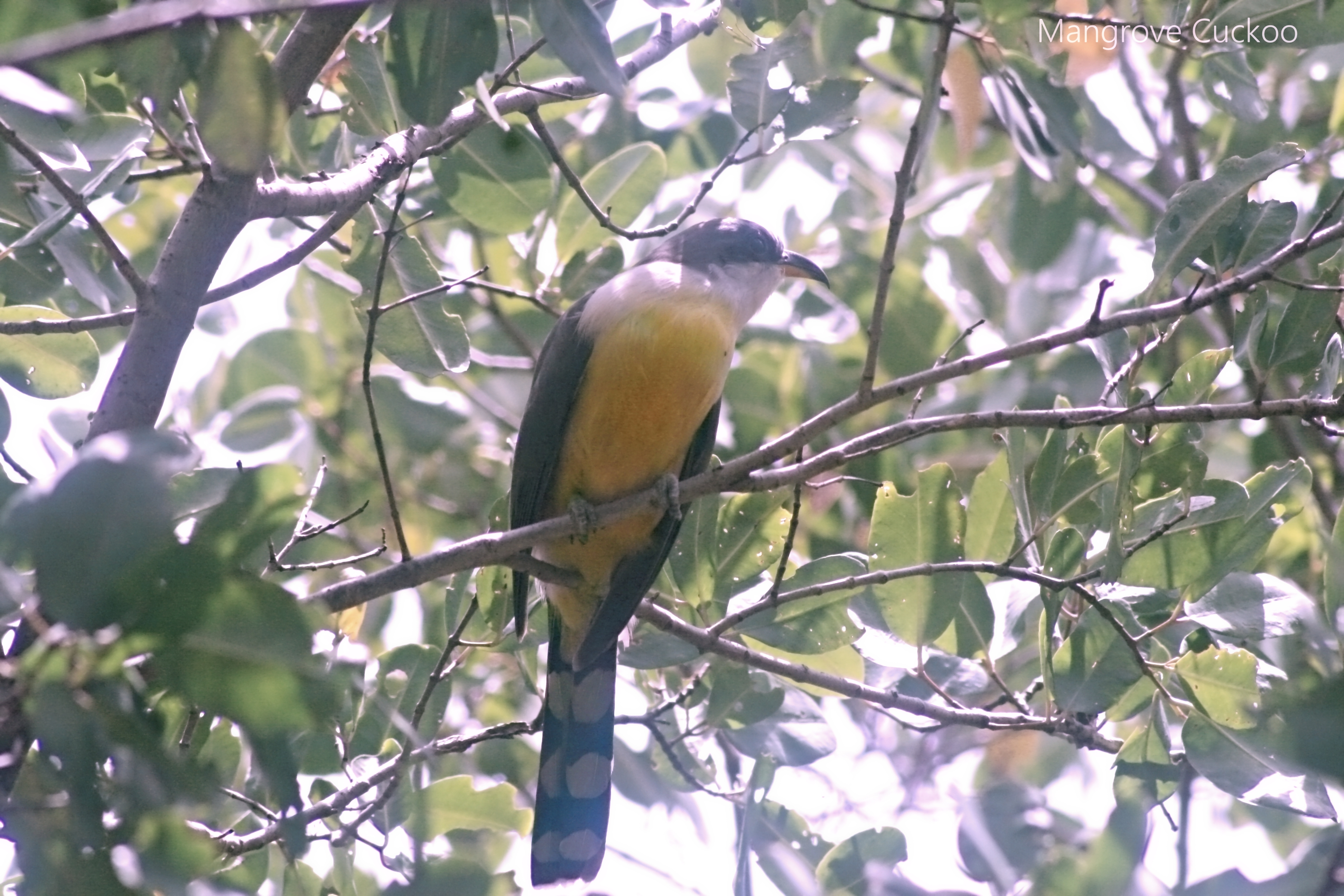
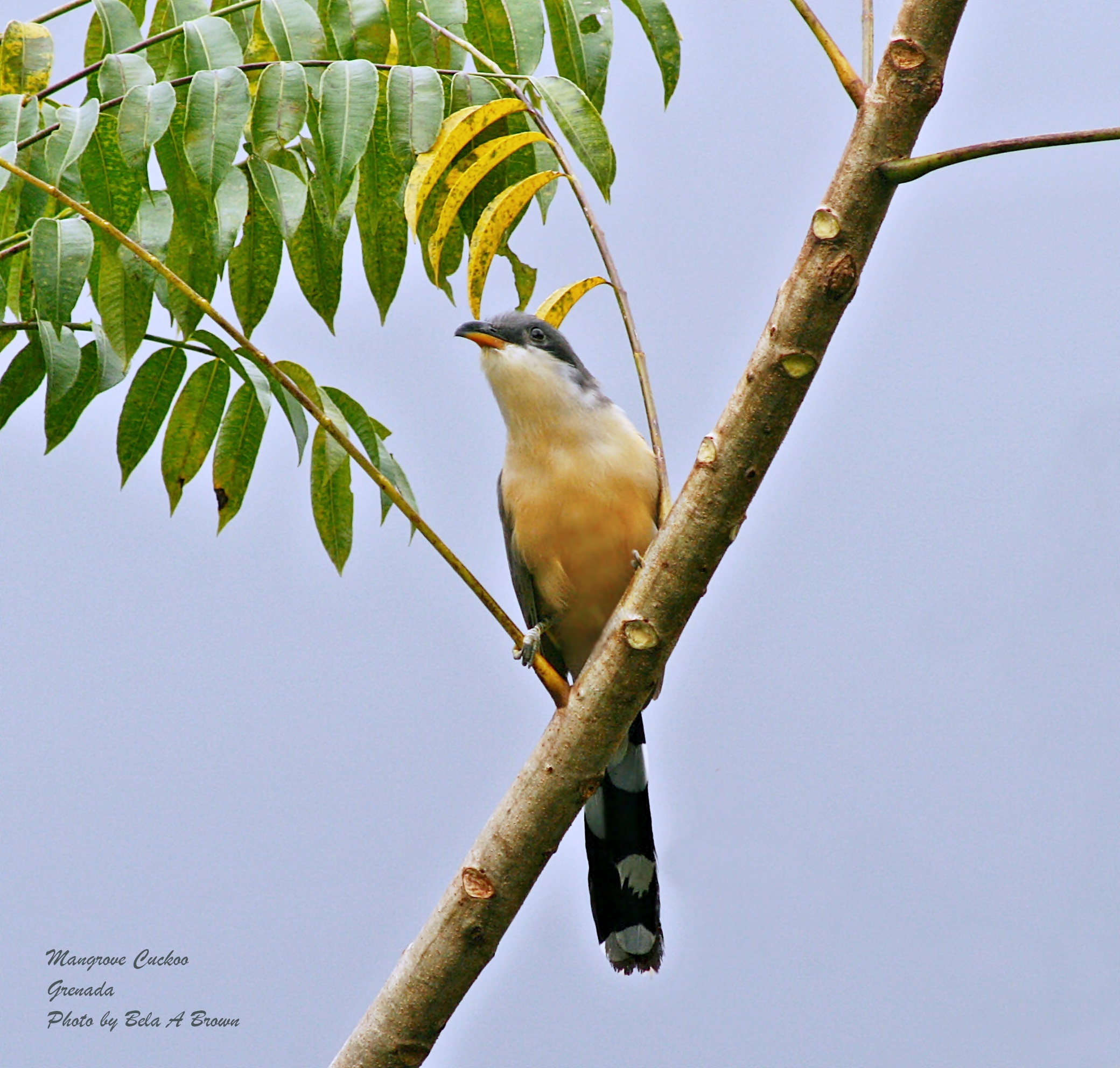
The Mangrove Cuckoo (Coccyzus minor) is a stunning medium-sized bird with yellowish-peach-coloured underparts, a long dark tail with white tips, a greyish-brown back, and a blackish face mask. Its bill is two-toned, black on the top and orange-yellow on the bottom with a dark grey tip. The eye ring changes from grey in breeding season to bright yellow the rest of the year. The Mangrove Cuckoo can be mistaken for the Yellow-Billed Cuckoo, especially on islands where they overlap, but the Yellow-Billed does not have a black face mask and has white underparts instead of peach. Also, its call is higher and faster than the Mangrove Cuckoo’s.
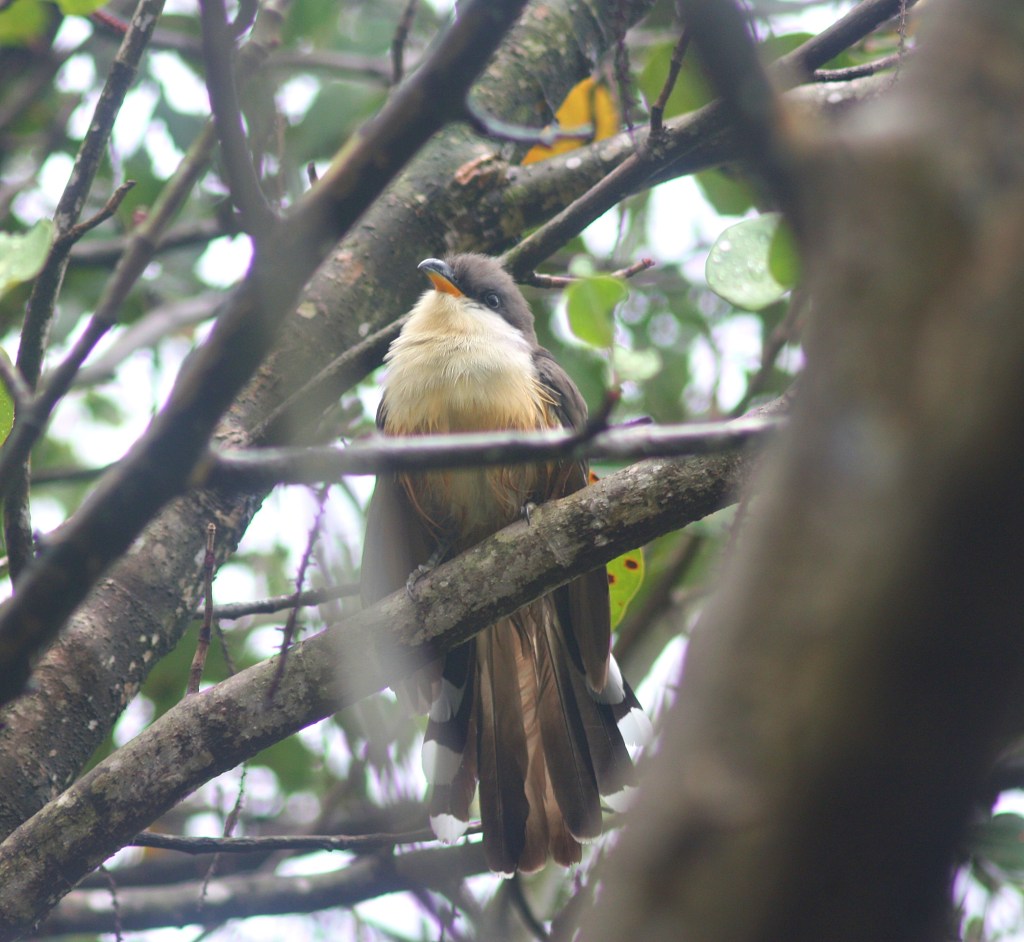
The Mangrove Cuckoo is part of the Cuculidae family, known for being more often heard than seen and preferring dense vegetation. Like most cuckoos, it is secretive and solitary, usually hidden from view and only noticed when it vocalizes. It stays still for long periods, turning its head to locate prey. It moves slowly along branches, using its long tail for balance. It rarely leaves cover and flies directly from one area to another with strong wingbeats followed by gliding. The Mangrove Cuckoo has zygodactyl feet, with two middle toes facing forward and two outer toes facing backward, helping it navigate branches.
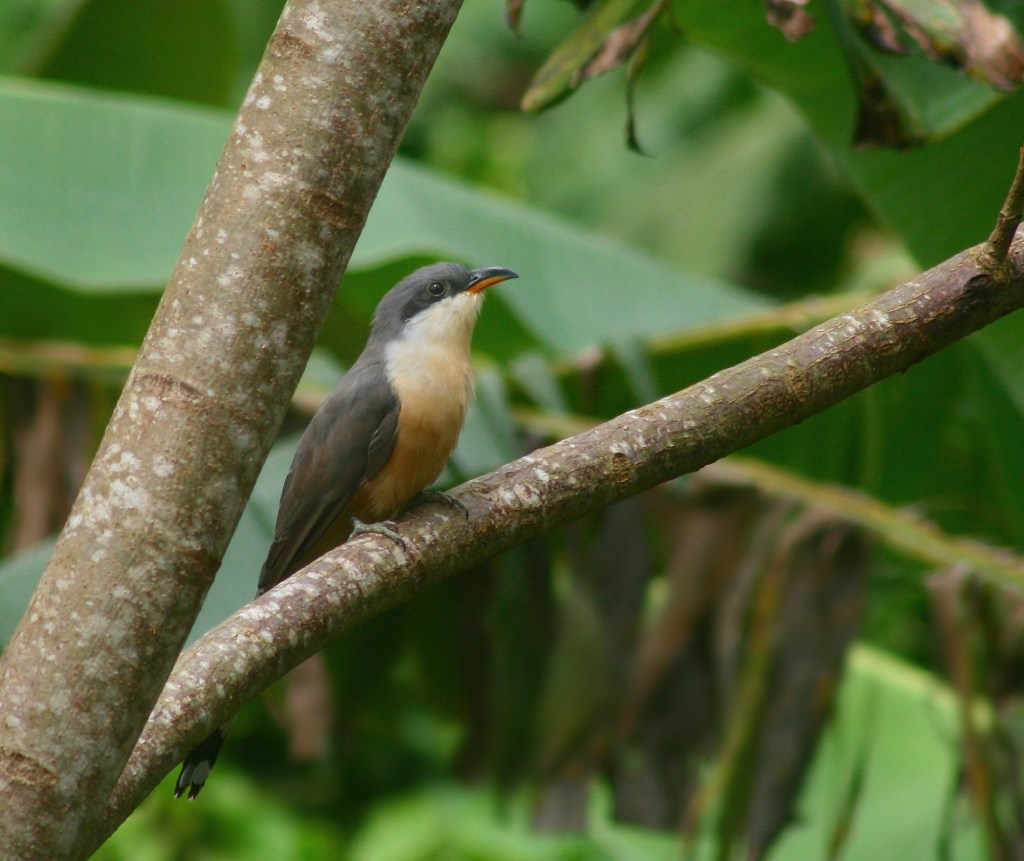
The Mangrove Cuckoo lives in the neotropics and is found year-round on many Caribbean islands, often hiding in mangrove swamps. Although it was once believed to be limited to mangrove forests, it now appears in various habitats. For example, in Grenada, I have seen individuals in the mangrove forests, coastal dry forest , cocoa plantations, as well as in higher humidity forests and cloud forests.
Its diet consists of both hairy and hairless caterpillars, insect larvae, grasshoppers, cicadas, stick insects and other large insects. It will also feed on berries, frogs and lizards; in fact, in Grenada they feed mainly on anole lizards during the dry season.
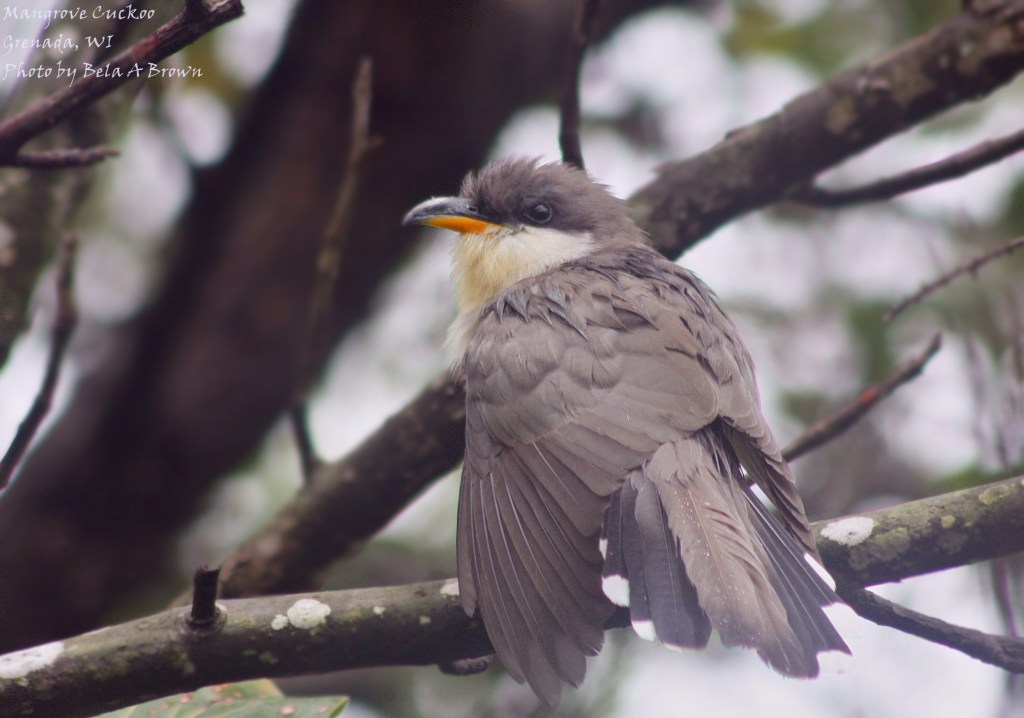
In the West Indies, the breeding season aligns with the rainy season, spanning from May to November, which coincides with a surge in the insect population. During courtship, the male attracts the female by elevating and fanning his long tail to showcase the striking white-tipped feathers. Once he captures her attention, he strengthens their bond with food offerings, perching on her upper back while holding the food morsel in his beak; she then tilts her head and raises her bill skyward to accept the gift. Interestingly, the female does not solicit food, so courtship feeding is performed voluntarily by the male at unpredictable intervals and is not a requirement for copulation. Pairs are monogamous, but the duration of their bonds remains uncertain.
Although nearly 40% of the Cuculidae family is known to practice brood parasitism, the Mangrove Cuckoo stands out as a law-abiding bird that constructs its own nest. True to its elusive character, it builds a solitary nest deep within the thick canopy, camouflaged with foliage to evade detection by predators. The female lays 2-4 cerulean-green eggs, which both parents incubate for approximately 9-11 days. During this incubation period, these birds have been observed to dive aggressively at potential threats, including housecats that venture too close to their nest.
The tiny hatchlings are born altricial—completely helpless, featherless, and reliant on their parents for food and protection. Mangrove Cuckoos take their parental care duties seriously, alternating in maintaining a vigilant watch over their young, issuing alarm calls to warn each other of nearby predators. Fortunately, the chicks grow quickly and can fledge to nearby branches as early as 6 to 10 days old. The youngsters look like a disheveled versions of their parents and spend their time climbing and hopping, making short flights from branch to branch, observing and learning from their parents, until it’s time for them to venture out on their own and become solitary cuckoos.
Mangrove Cuckoos, often referred to as ‘Rain Crows,’ have a tendency to vocalize more on overcast days. This behavior has led them to gain a reputation for forecasting rainfall, and indeed, it often rains following their calls!

 BELA'S BIRDS