
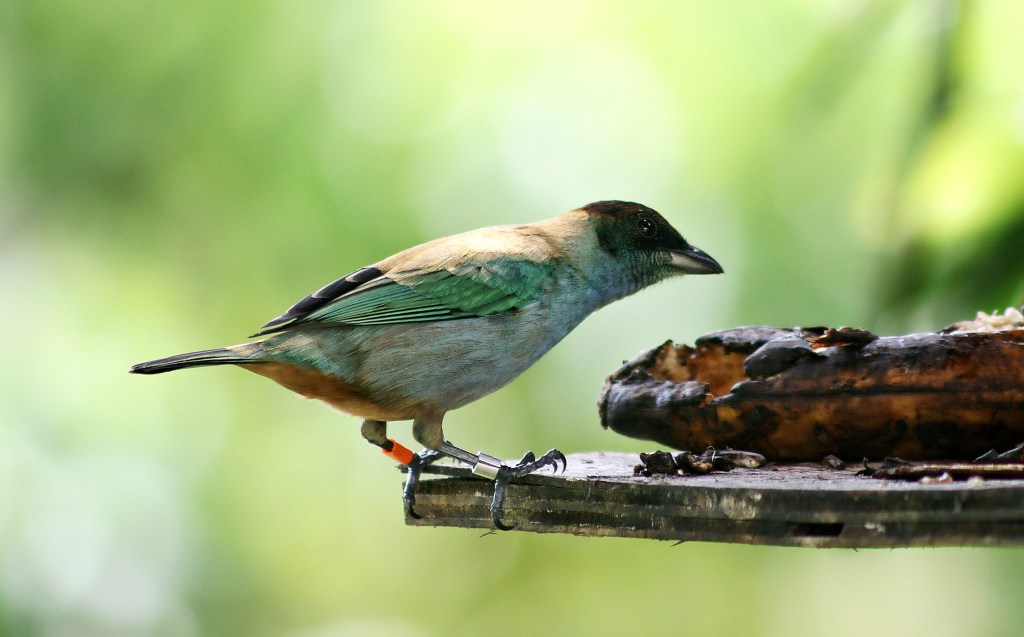
The Lesser Antillean Tanager is a bird found only on the islands of Grenada and St. Vincent and the Grenadines. This attractive tanager is believed to have arrived in the Lesser Antilles from South America around ten million years ago. While unique to the West Indies, it is part of the cayana group, which includes the Scrub Tanager (Tangara vitriolina) from Colombia and the Burnished-Buff Tanager (Tangara cayana), found in Brazil, the Guianas, and Venezuela. Molecular studies show that the Lesser Antillean Tanager is more closely related to the Colombian Scrub Tanager than to its nearby neighbor. Birds in the cayana group have bluish-green and buff feathers with a distinctive chestnut or rusty cap, exhibit sexual dimorphism, and prefer semi-open habitats rather than dense forests like other Tangara species.

The sexes of the Lesser Antillean Tanager can be easily distinguished by their colors, especially when seen together, as they often travel in pairs. Males have a dark-chestnut cap, metallic gold back, violet underparts, turquoise wings, and a black eye mask. Females are mostly green with a brighter rusty cap, and there are some variations that can confuse birders. Juveniles look like adults but are duller and do not have the eye mask.
There are two regional types of the Lesser Antillean Tanager that can be easily told apart by their plumage color in good light. The Grenadian type, Stilpnia cucullata cucullata, has duller feathers and a darker cap compared to the St. Vincent type, Stilpnia cucullata versicolor. Vincentian females are browner than those from Grenada. Specimens from the Grenadines are often hard to classify into either type.
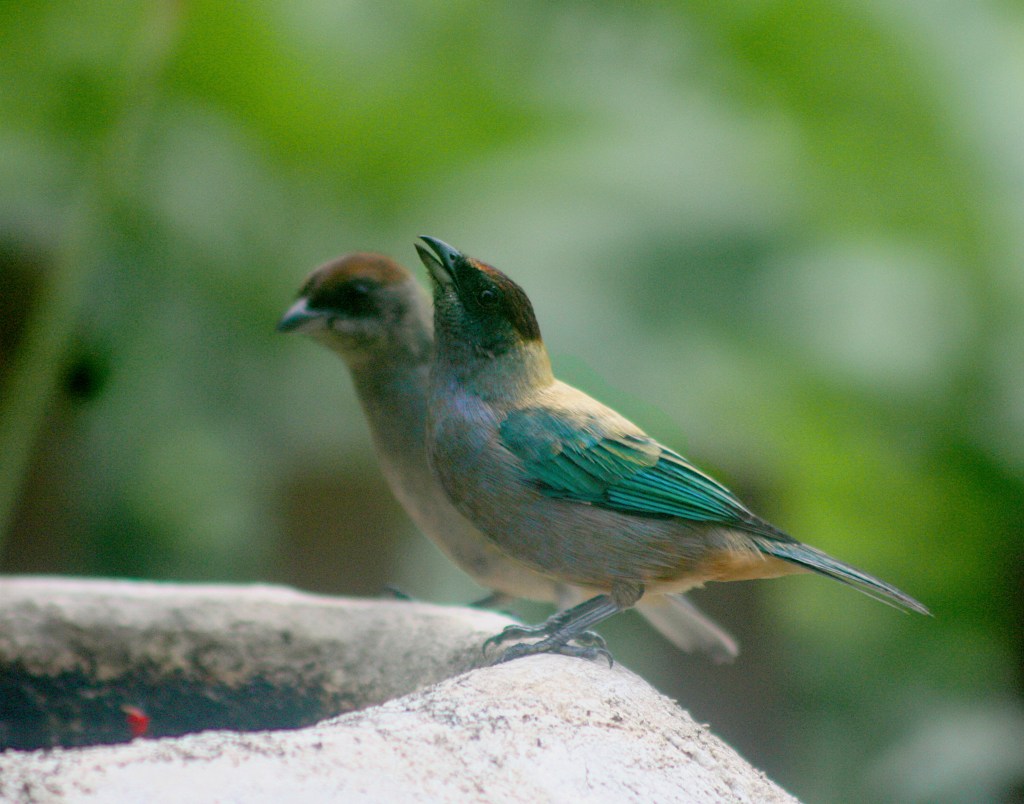
The Lesser Antillean Tanager is an omnivorous bird that mainly eats fruits and wild berries, along with some insects. It especially likes bananas, mangoes, soursop, and lantana berries. Usually found in pairs or small groups, this attractive tanager is often heard chirping loudly. While it is shy around people, it is very social with other tanagers, particularly during the breeding season from April to July, when males make loud whistles – ‘_weet-weet-weet-witwitwit!!’ – to claim their territory.
Couples are seasonally monogamous and build cup-shaped nests in low trees or shrubs, about 2 to 6 meters off the ground, often near human homes to avoid predators. They mainly use small twigs, dried grasses, and leaves for nesting materials and may occasionally take from other birds’ nests. Once the nest is nearly finished, the female lays two eggs and incubates them alone for about two weeks while the male stays close by. He guards the nest from intruders and occasionally visits, making soft, caring sounds. Sometimes, he feeds the female while she is sitting on the eggs.
Both parents nurture and feed their chicks, though the female typically visits the nest more often than the male. While at the nest, they stay silent or emit soft sounds to minimise detection. Significant threats to their eggs and chicks come from snakes, mongooses, rats, and larger birds.
The species, which has a very limited range, experienced a significant drop in population after Hurricane Ivan hit in 2004. Nevertheless, it rebounded quickly, likely because it prefers semi-open habitats. This bird seems to adapt well and even gain from human activities. Today, it is quite common across its entire range, found at all elevations in gardens, parks, dry and moist forests, dry scrubs, forest edges, plantations, and rain forest canopies.
The Lesser Antillean Tanager has a curious fascination with mirrors, particularly the side-view mirrors of parked cars! While many birds may take a quick look at their reflections, this Tanager can become mesmerised for hours, entranced by its vivid image, poking, lunging, and flashing its wings like a fiery matador. Yet, the Tanager isn’t simply admiring its own appearance; it is actually agitated by the ‘other’ bird in the reflection, which it sees as a rival. At times, I have covered the mirrors to stop the little bird from wasting its energy battling imaginary foes!



 BELA'S BIRDS