
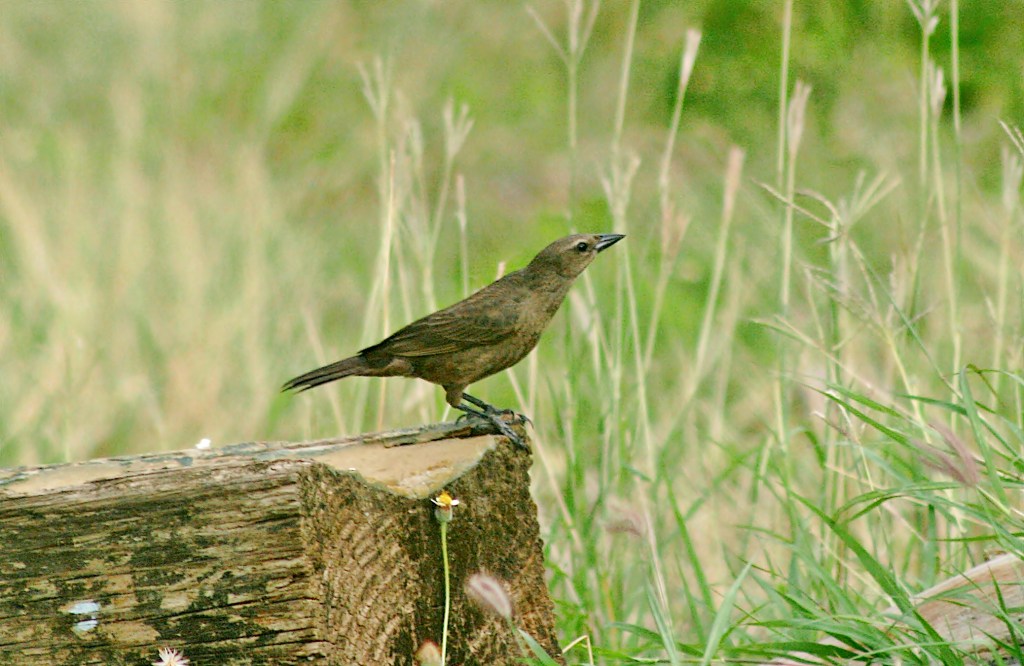
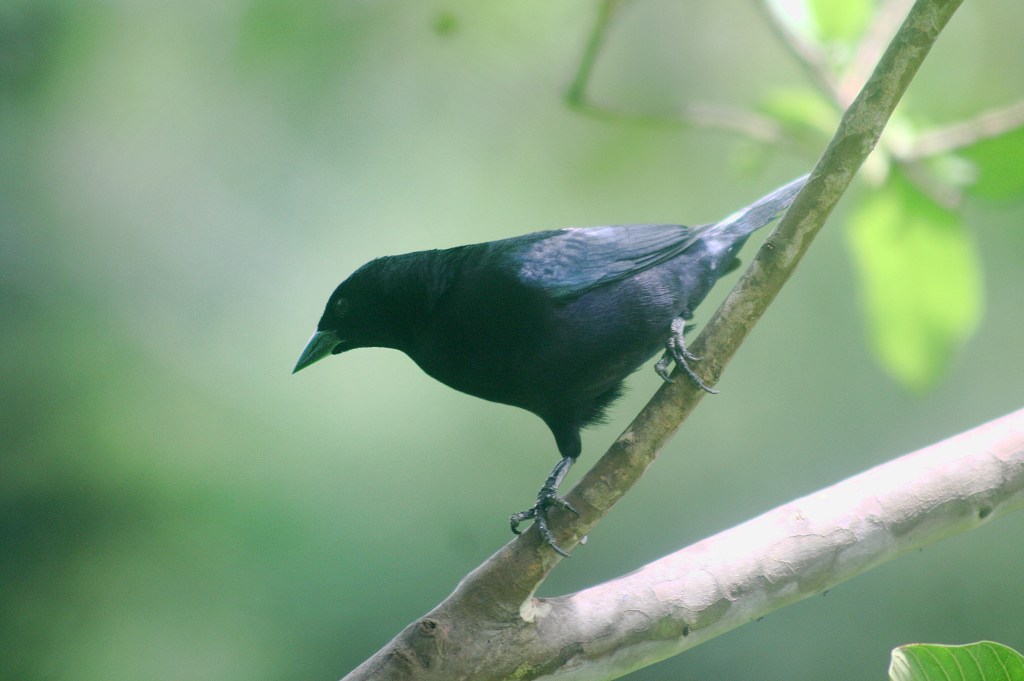
There’s this prowler in my neighborhood, and it’s pretty wild. Dressed in muted colors, she lingers about, biding her time for homes to be unoccupied. At dawn, she slips in and out with stealth and confidence, yet she never takes anything; instead, she leaves her own treasures behind! This isn’t your average prowler; it’s a Shiny Cowbird, known for laying her eggs in the nests of other birds!
Shiny Cowbirds are obligate brood parasites—this means they’ve lost the ability to construct their own nests and incubate their eggs, relying entirely on other birds to fulfill their breeding cycle. Did you know that approximately 1% of all bird species are obligate brood parasites, with the most well-known examples being cowbirds and the European cuckoo?
A nomadic lifestyle
The Shiny Cowbird is a medium-sized songbird with a name that comes from its old ties to bison and cattle. Back in the day, cowbirds used to follow the massive herds of bison that wandered North America, munching on the insects that got stirred up by the herd. There’s a theory that these wandering bison had something to do with the bird’s notorious breeding habit of laying eggs in other birds’ nests since chasing after a moving herd was way easier than dealing with building a nest and raising its own chicks!
The Shiny Cowbird is native to the pampas, which are extensive grasslands found in South America. There are seven subspecies of the Shiny Cowbird, all located in South America, except for the Molothrus bonariensis minimus, the smallest subspecies, which was originally restricted to northern Brazil, the Guianas, and Trinidad and Tobago. This particular subspecies has recently expanded its range to the Lesser Antilles, beginning its colonization in Grenada in 1901 and progressively moving up the island chain to reach Antigua by 1959. While it is considered rare in the Virgin Islands, it is widespread in Puerto Rico, Hispaniola, Jamaica, Cuba, the Bahamas, and some areas of Florida. The species was first documented in Grand Cayman in 1995.
Populations in South America and Florida are partially migratory, but those in the West Indies appear to remain sedentary all year round.
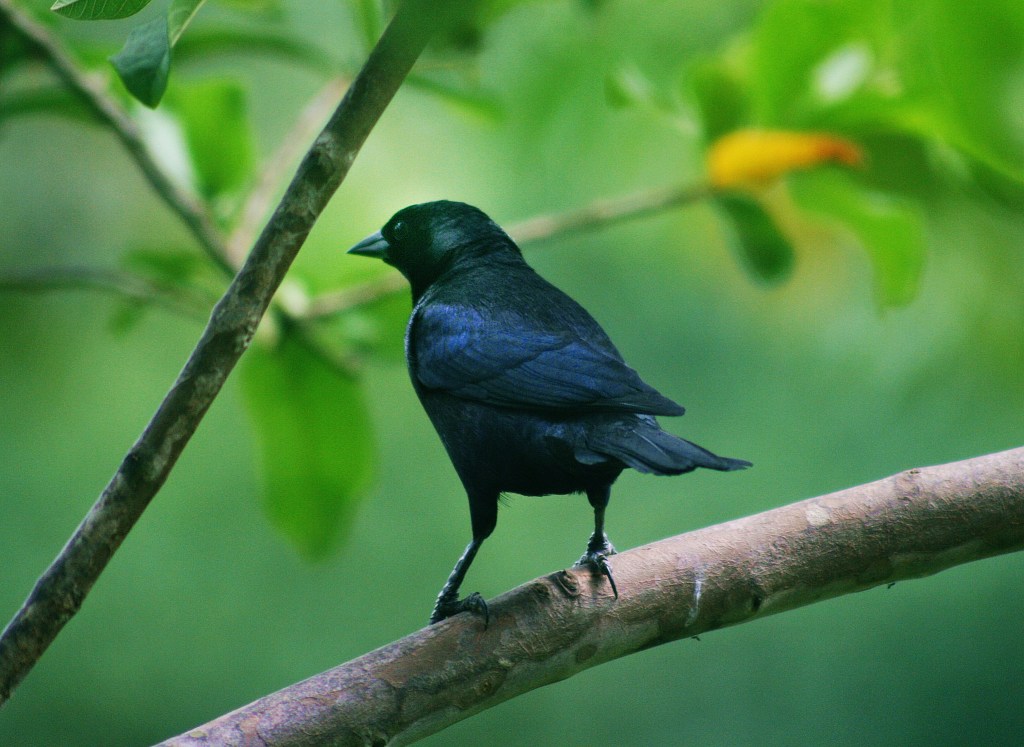
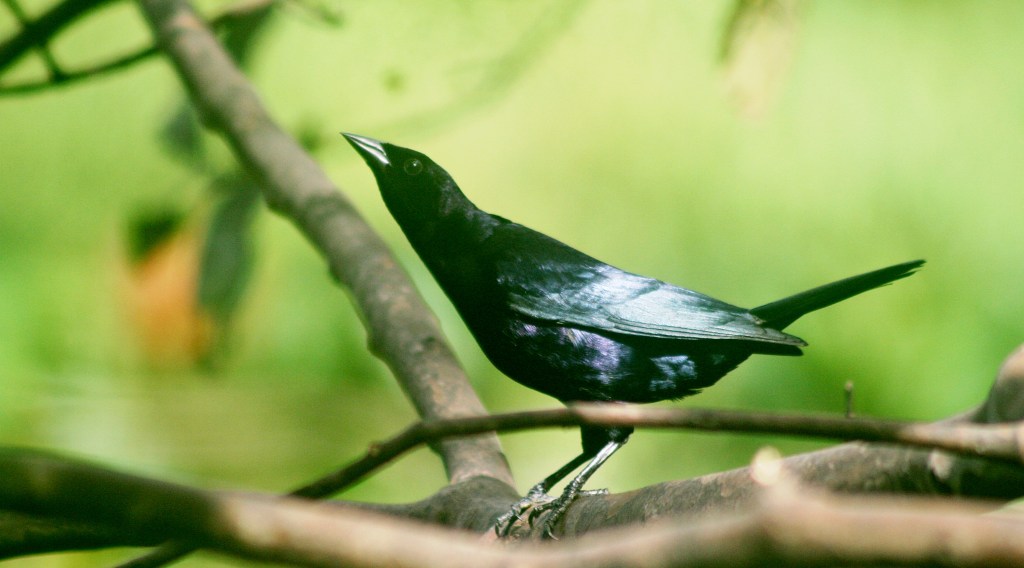
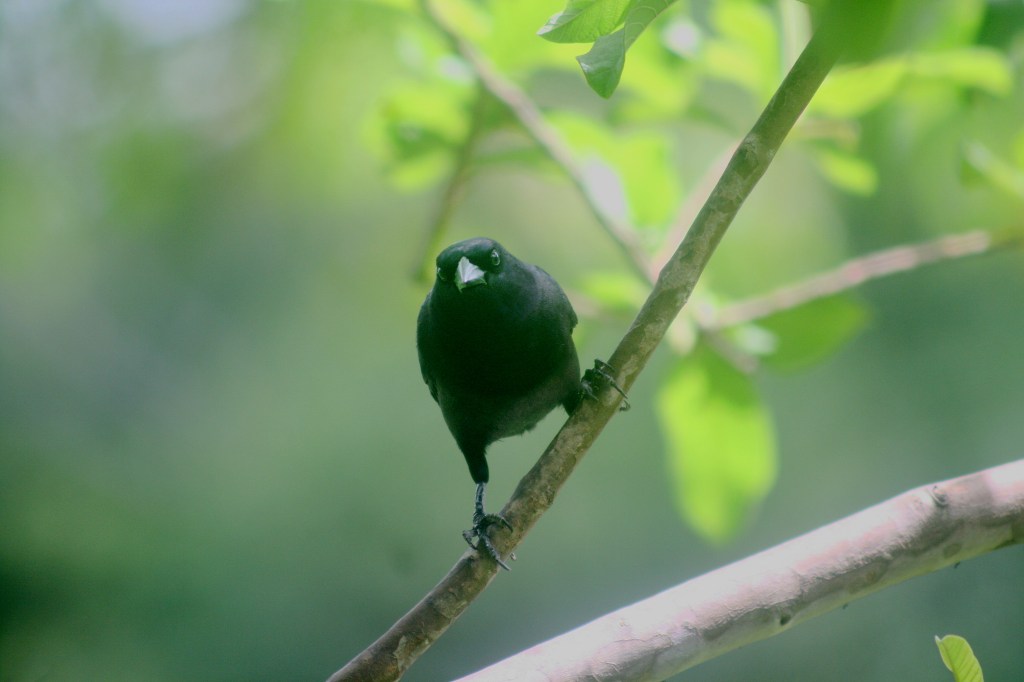
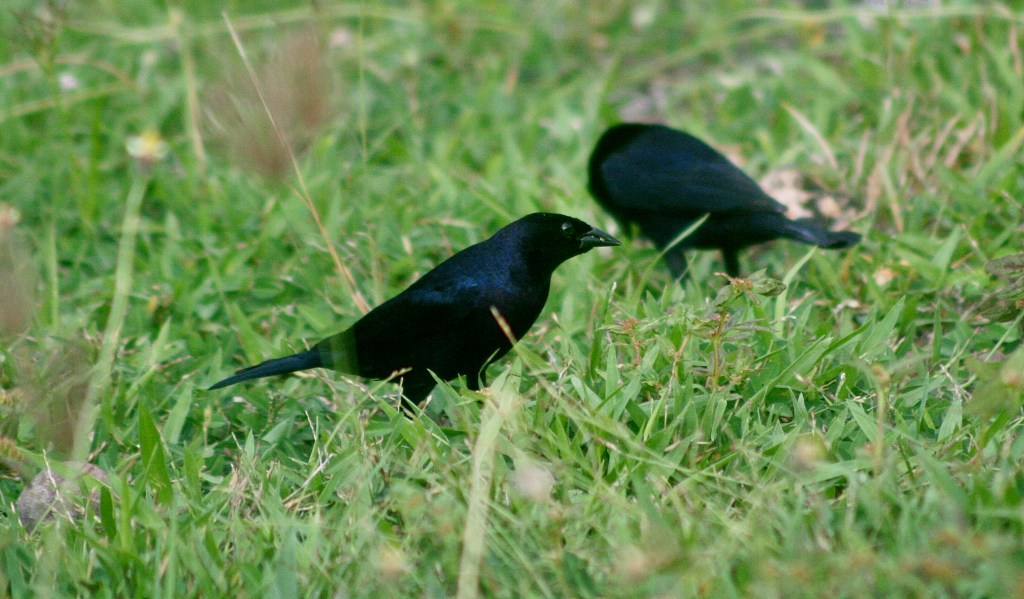
Despite being a recent newcomer to the West Indies, the Shiny Cowbird has already acquired several local names, including Merle de Sainte-Lucie, Merle de Barbade, Corn Bird, and Blackbird’s Cousin. Most of these names stem from the male Shiny Cowbird’s glossy black plumage, which shimmers with iridescent blues and violet highlights in the sunlight. While males can be mistaken for their close relatives, the glossy black-violet Carib Grackle, Shiny Cowbirds are smaller, featuring dark eyes and a shorter, thicker bill. Females are simple and inconspicuous, dressed in muted shades of brown.
As ground-foraging omnivores, Shiny Cowbirds are often spotted in open agricultural fields as well as urban parks, outdoor cafés, and restaurants, where they eagerly scavenge for crumbs left beneath tables. These birds flourish near human populations, rapidly adapting to human presence. Their rapid population growth has been significantly supported by the deforestation of both dry and rain forests for agricultural and grazing activities.
Did you know that in the early 1900s, they were preferred as cage birds because of their melodic songs? However, they have since fallen out of favor due to their breeding behaviors, which makes them widely unpopular!
Mastering Brood-Parasitism
But let’s explore this infamous brood parasite in more detail; while the bird cleverly avoids the labor of building a nest and providing parental care altogether, mastering the act of brood parasitism is no simple feat! First and foremost, Shiny Cowbirds must make sure that the host’s diet includes the correct nutrition for the parasitic chicks so that they do not starve. Timing also plays an essential role—if eggs are laid too early, they will sit in an empty nest, raising the host’s suspicions; if laid too late, the chicks may not get the necessary surrogate care. To initiate this process, Shiny Cowbirds start by locating a bird carrying nest material in its beak and follow it to investigate. Afterwards, they visit the prospective nest several days in advance to fine-tune their timing, making at least a dozen trips before laying their eggs.
While some cowbird species may return to host nests multiple times after laying their eggs, Shiny Cowbirds lay just one egg and then completely avoid the nest. This behavior is likely due to their habit of poking holes in some or all of the eggs they come across. As a result, avoiding nests they have already visited is a strategy to prevent damaging their own egg. There are several hypotheses that explain the reasoning behind egg puncturing, with two being particularly significant: the “farming hypothesis,” which suggests that if a female cowbird finds a nest late in the incubation process, she punctures the eggs to “motivate” the host to re-nest, thus creating new opportunities for herself. The second is the “test incubation hypothesis,” which claims that by puncturing the eggs, the female evaluates the embryos’ development to decide if the nest is worth parasitising.
Additionally, Shiny Cowbirds follow the age-old proverb, “don’t put all your eggs in one basket,” as they generally avoid laying more than a single egg in any nest to minimise competition among their young. Therefore, if a nest holds multiple cowbird eggs, it is likely that several females have parasitized it.
Although some brood parasitism relies on only a few host species, Shiny Cowbirds are remarkable generalists that exploit as many as 250 different host species, with 93 confirmed to have successfully raised Cowbird chicks. A few of these species tolerate parasitism, while others, like the Grey Kingbird, fiercely guard their nests and quickly identify the parasitic eggs, ejecting them from their nests. Moreover, some species will reconstruct their nests to conceal the intrusive egg.
Effects of Brood Parasitism
Whereas brood parasitism benefits the Cowbird tremendously by allowing it to allocate all of its resources towards mating and producing eggs, resulting in a longer reproductive period, it can harm the host by decreasing the growth of its offspring as they compete with more aggressive, competitive parasitic siblings. Shiny Cowbird eggs have a shorter incubation period than the hosts’, giving the hatchlings a tremendous head start. As a result, Shiny Cowbirds are a serious threat to some host species in the West Indies, particularly endangered species such as the Yellow-Shouldered Blackbird of Puerto Rico and the Puerto Rican Vireo.
Cowbirds might be the mafiosos of the bird world, but they begin their lives facing an identity crisis, as their chicks are raised by families that not only look different but also sound quite unlike them. Laboratory experiments show that cowbirds who spend too much time with their foster parents imprint on them and end up learning their songs and behaviors and even attempt to mate within the host species.
Yet, left in a natural habitat, their instincts can override this; a study published in Animal Behaviour reveals that, like unruly teenagers, Cowbird fledglings sneak out of their foster parents’ nests at night to rendezvous with other cowbirds in the nearby fields, returning to the nest just before dawn. These night flights, driven by a longing to roost in the fields, ensure the youngsters mingle and build ties with their own species.
Additionally, a recent study found that, contrary to all expectations, female cowbirds don’t abandon their offspring completely. Instead, they look out for them and return to nests where their chicks have survived to pre-adulthood, responding to their begging calls with vocalizations. At the same time, they gather information on the successes and failures of different nests to help them decide where to lay in the future. Curiously, neurological studies have found that females develop larger hippocampal formations (the part of the brain linked to acquiring spatial memory) than males. This is because the females alone carry out parasitic behavior and need the capacity to remember the location and status of each nest for future identification.
People used to think cowbirds just laid their eggs in the first nest they could find, but now we know that they work hard to provide the best foster care for their chicks. As you see, there is more to the prowler in my neighborhood than meets the eye!

 BELA'S BIRDS
One thought on “Shiny Cowbird: a prowler on the loose”